EN
Play
The art book

The chronicle of Chorin in pictures

The miniature of the abbey in each era, the illustrations of the chronicle pages and the people who lived there.

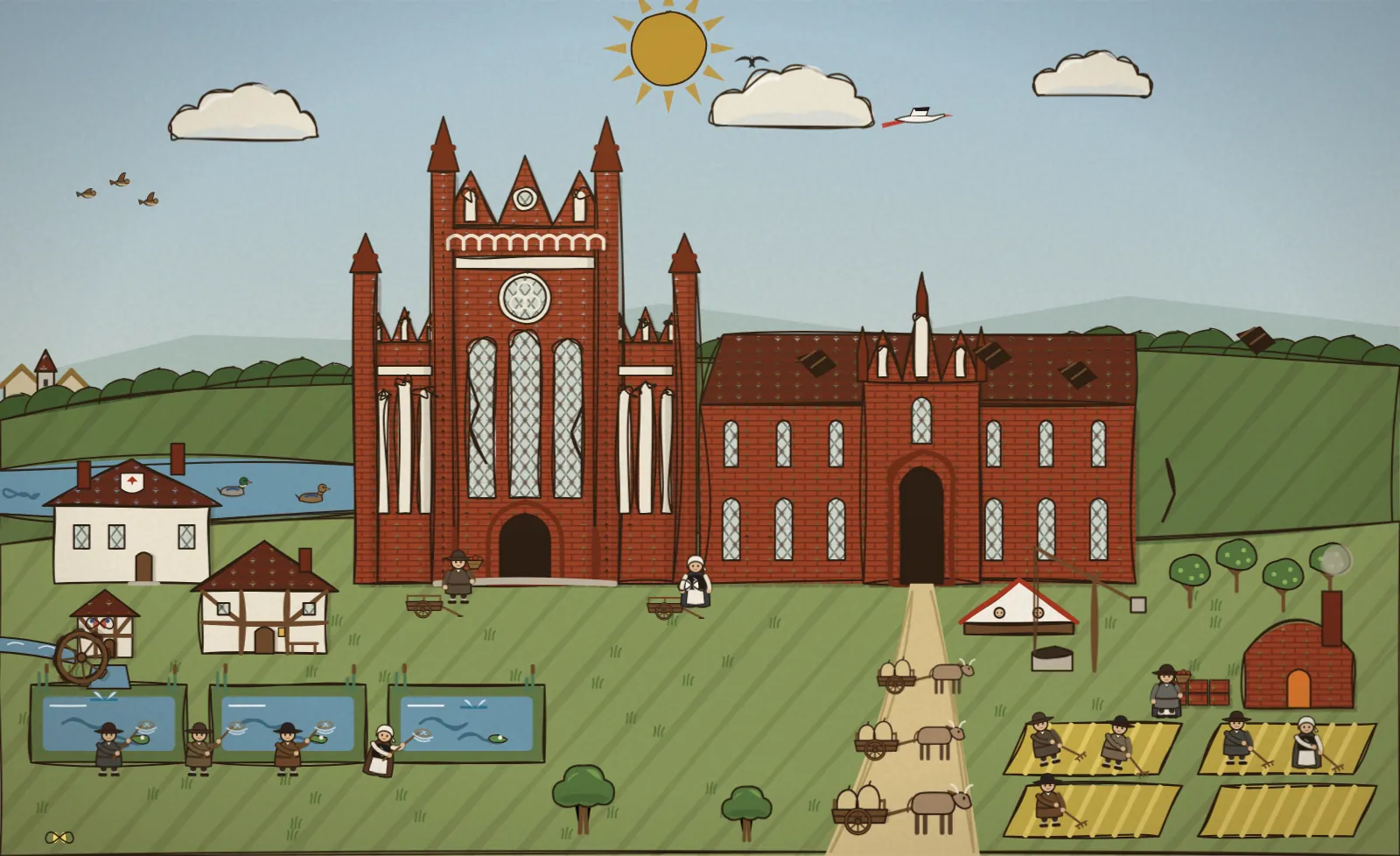
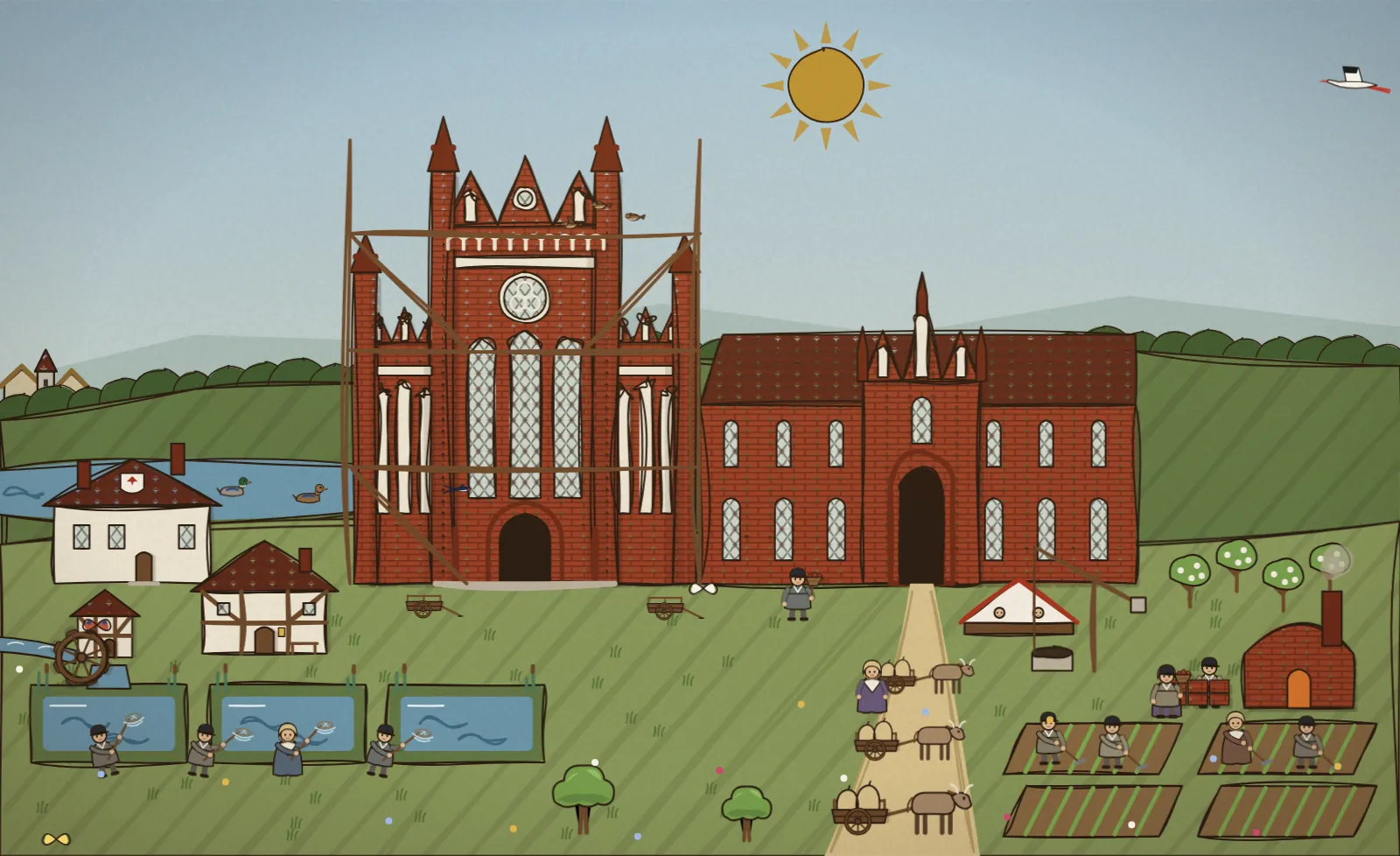
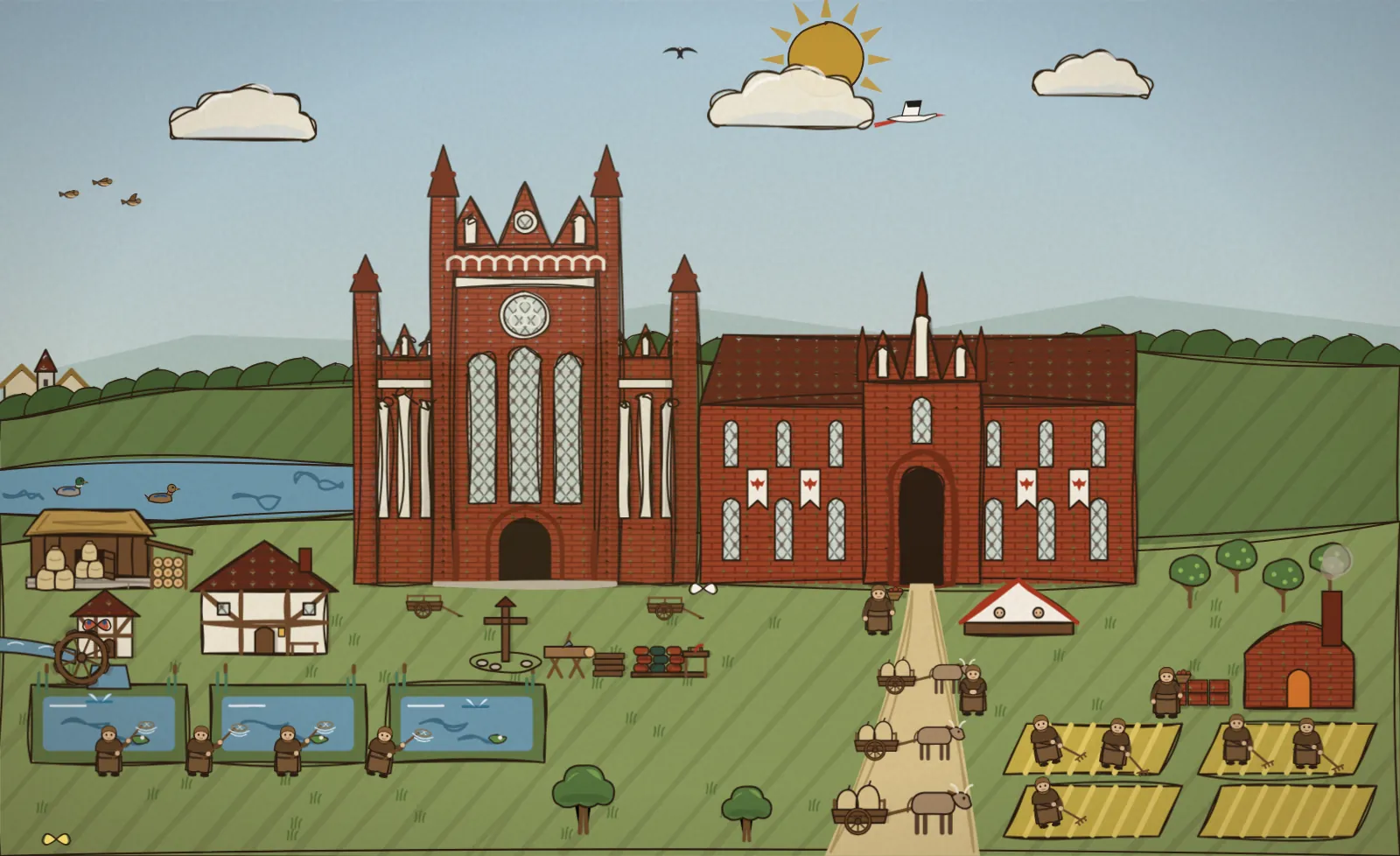
The abbey in its heyday, a summer noon
Era I

Mariensee and Chorin, 1258–1300

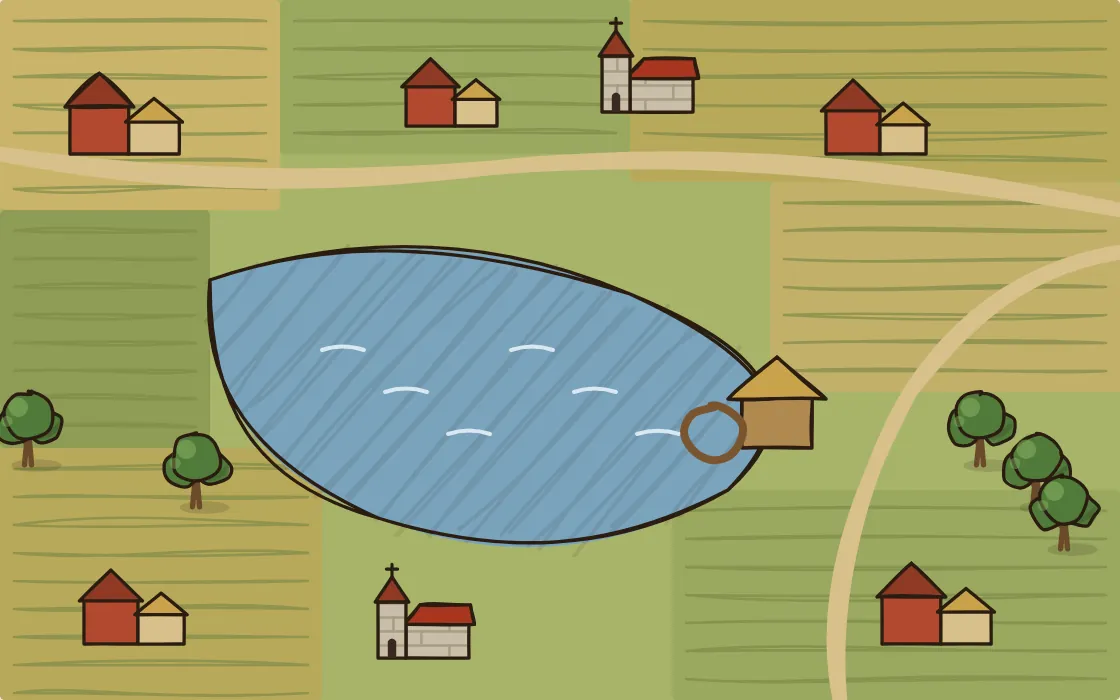
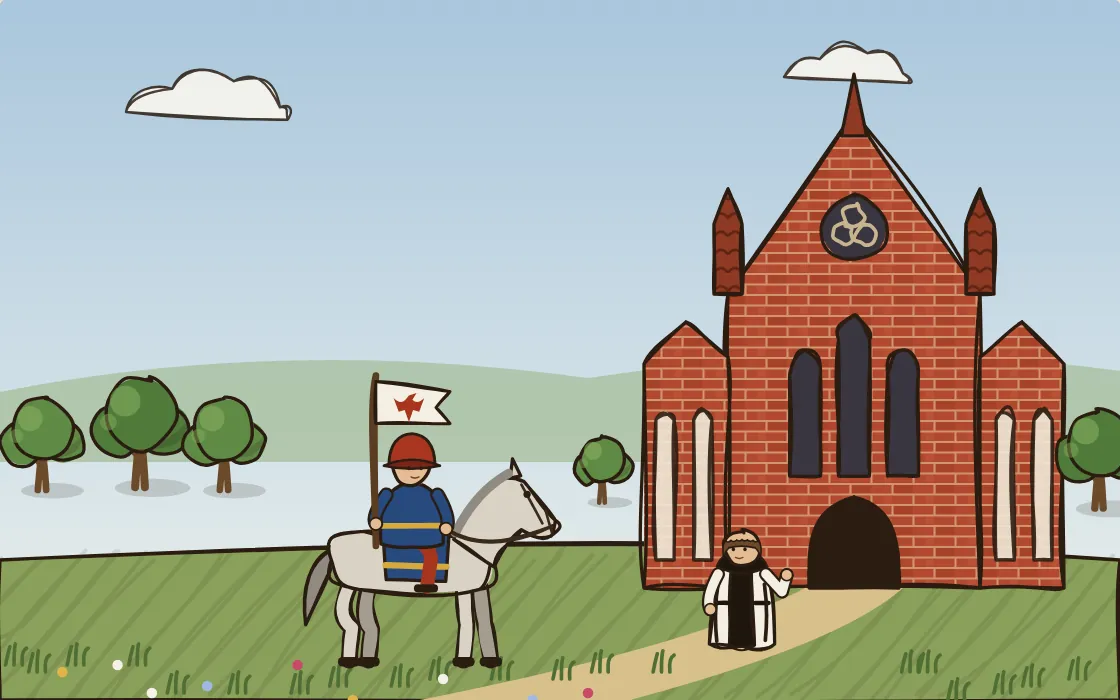
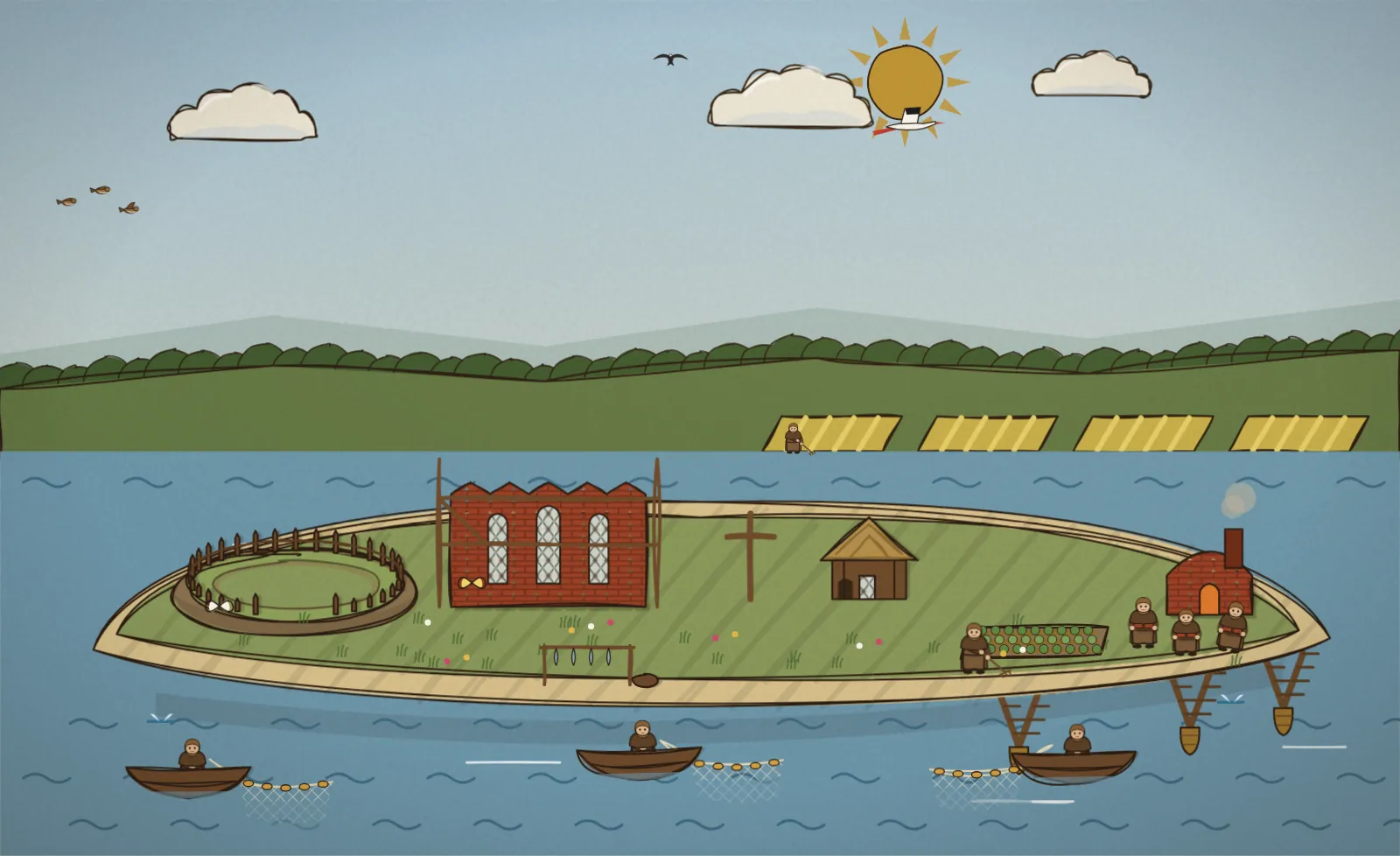
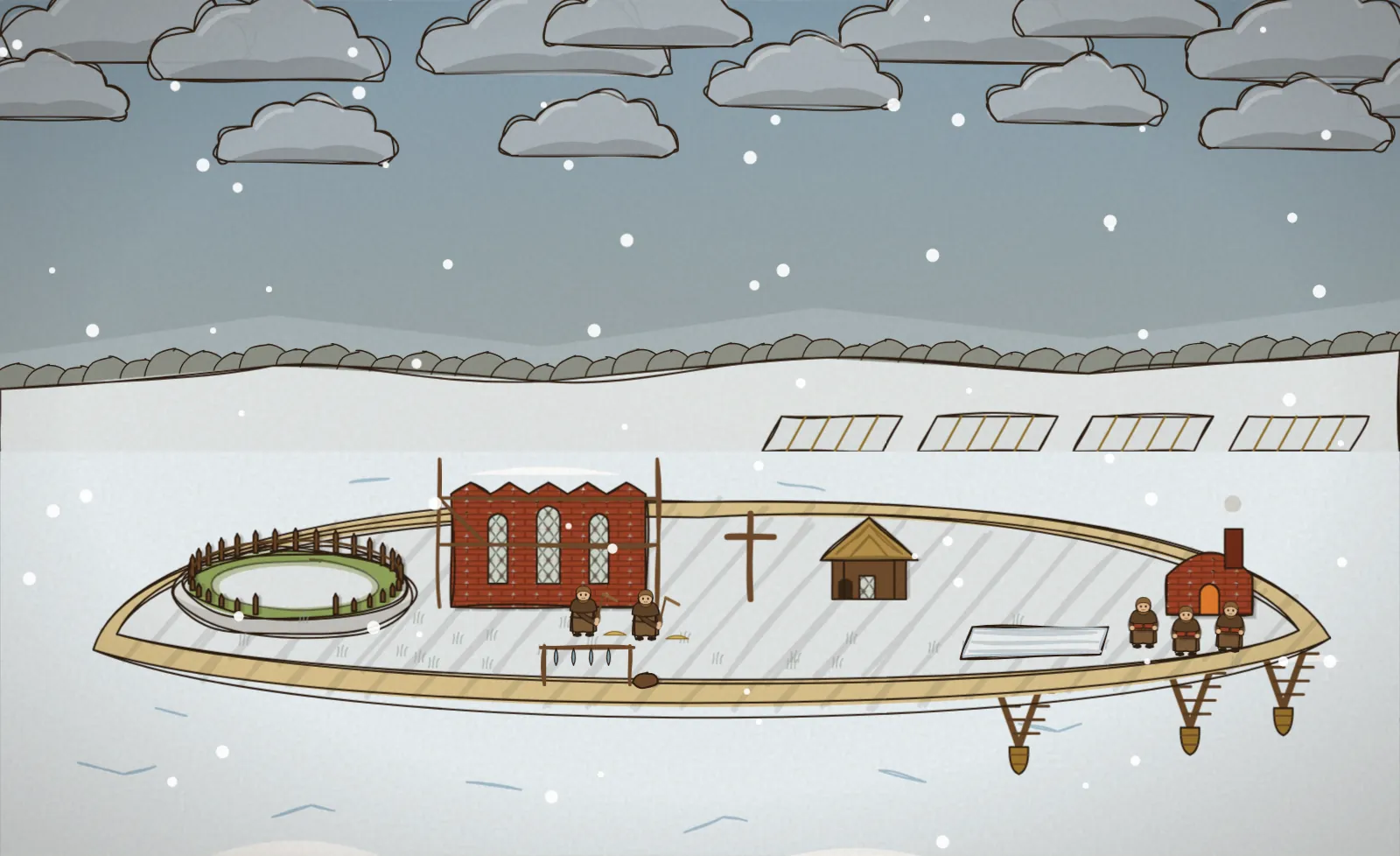
In 1258 the margraves have a Cistercian abbey founded on an island in Lake Parstein: Mariensee. In 1273 it moves to the lake of Chorin, and its brick church rises from the choir to the west front.

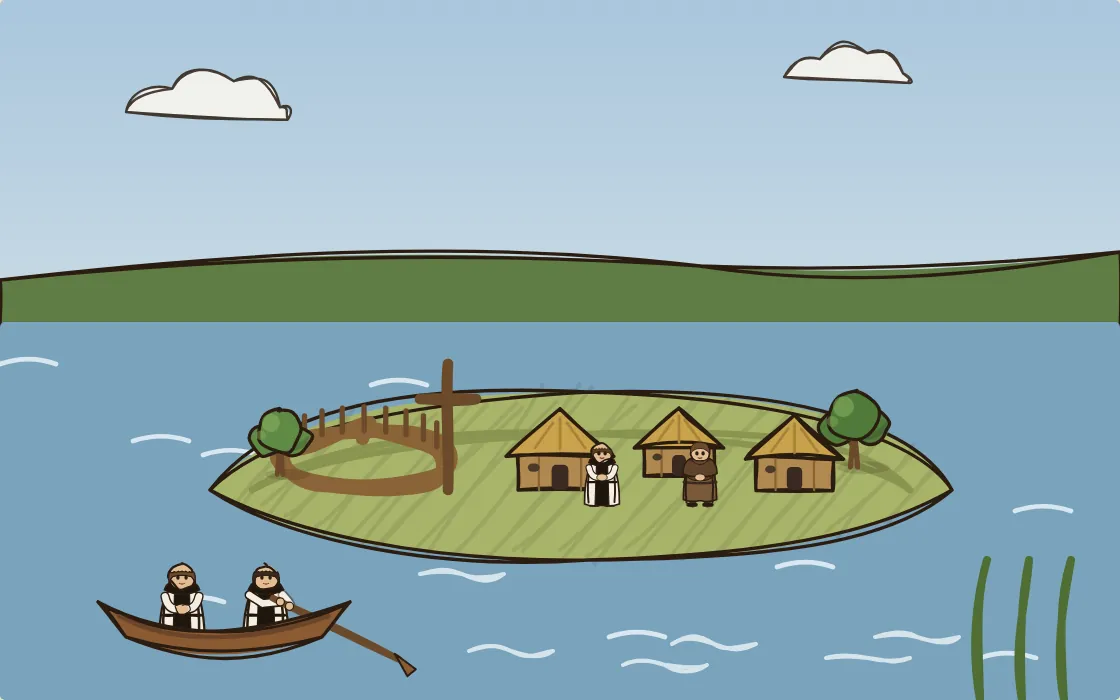
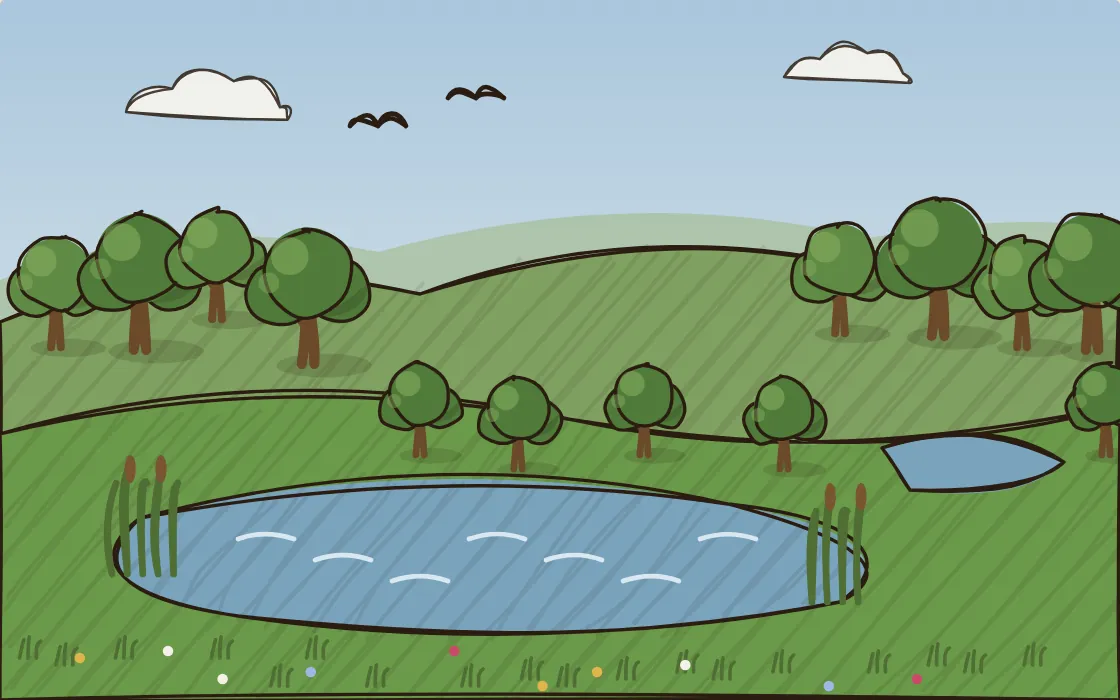
Mariensee, the island in Lake Parstein: a summer morning
Mariensee in winter
Mariensee in winter
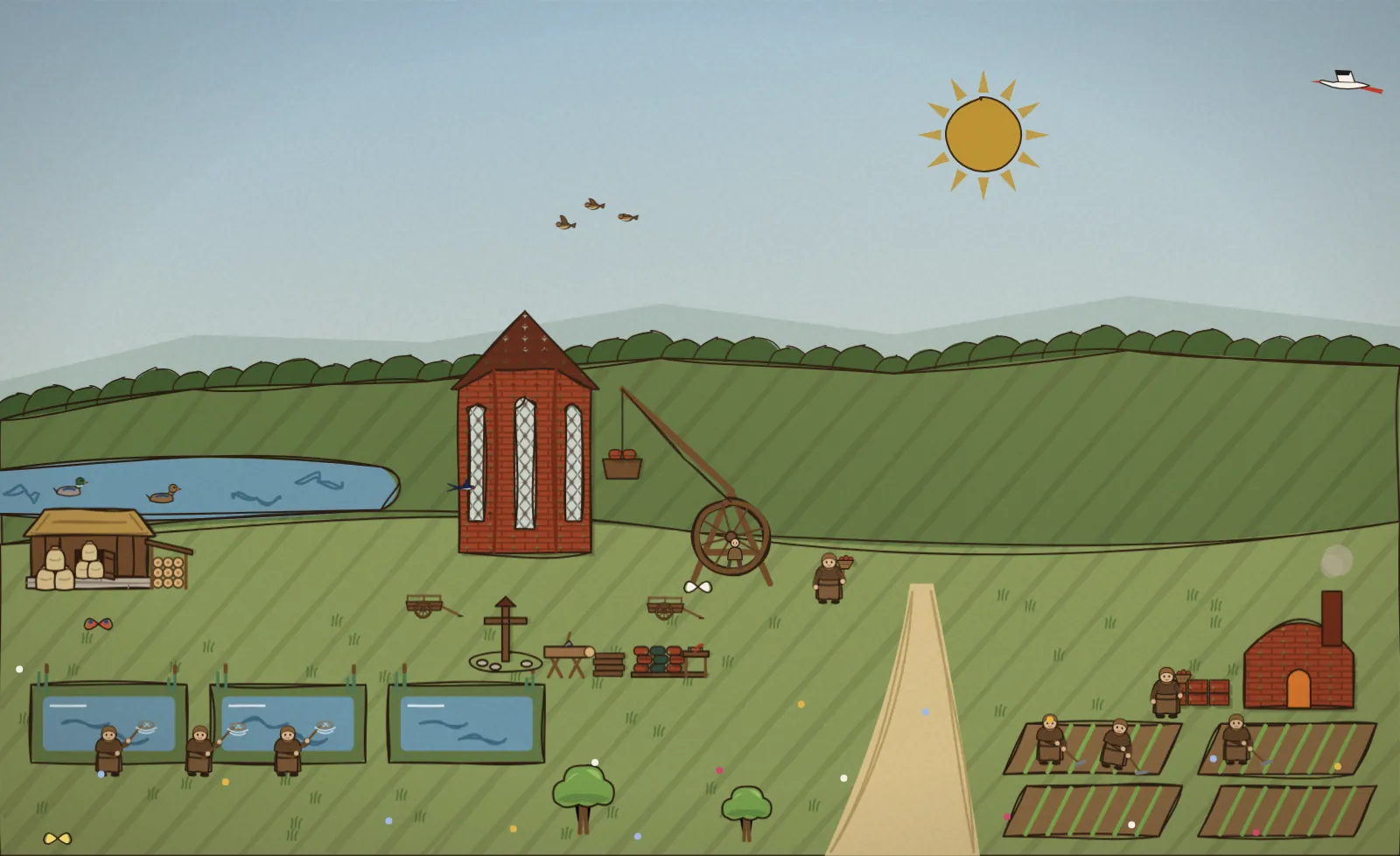
Chorin: the new church rises, a spring morning
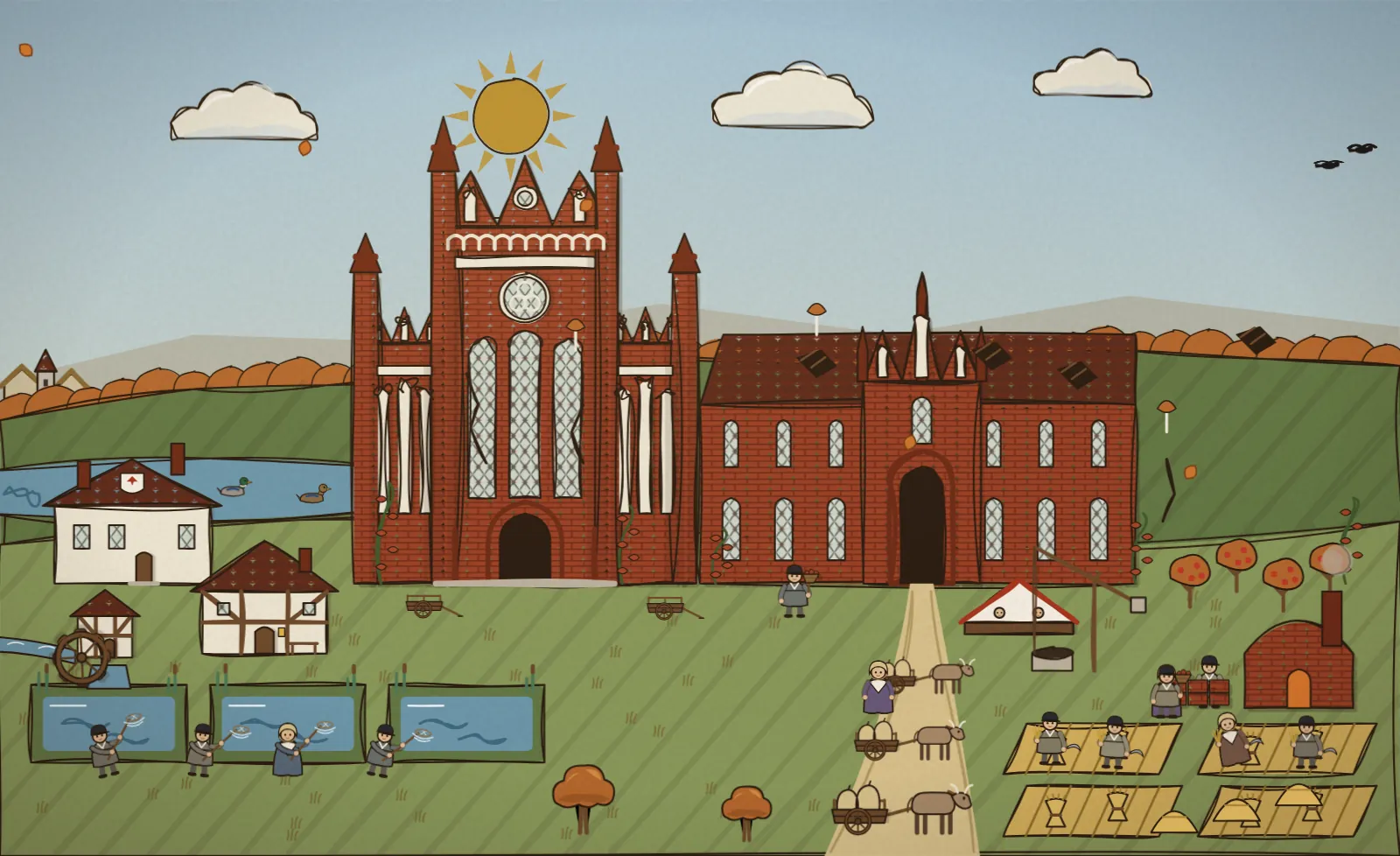
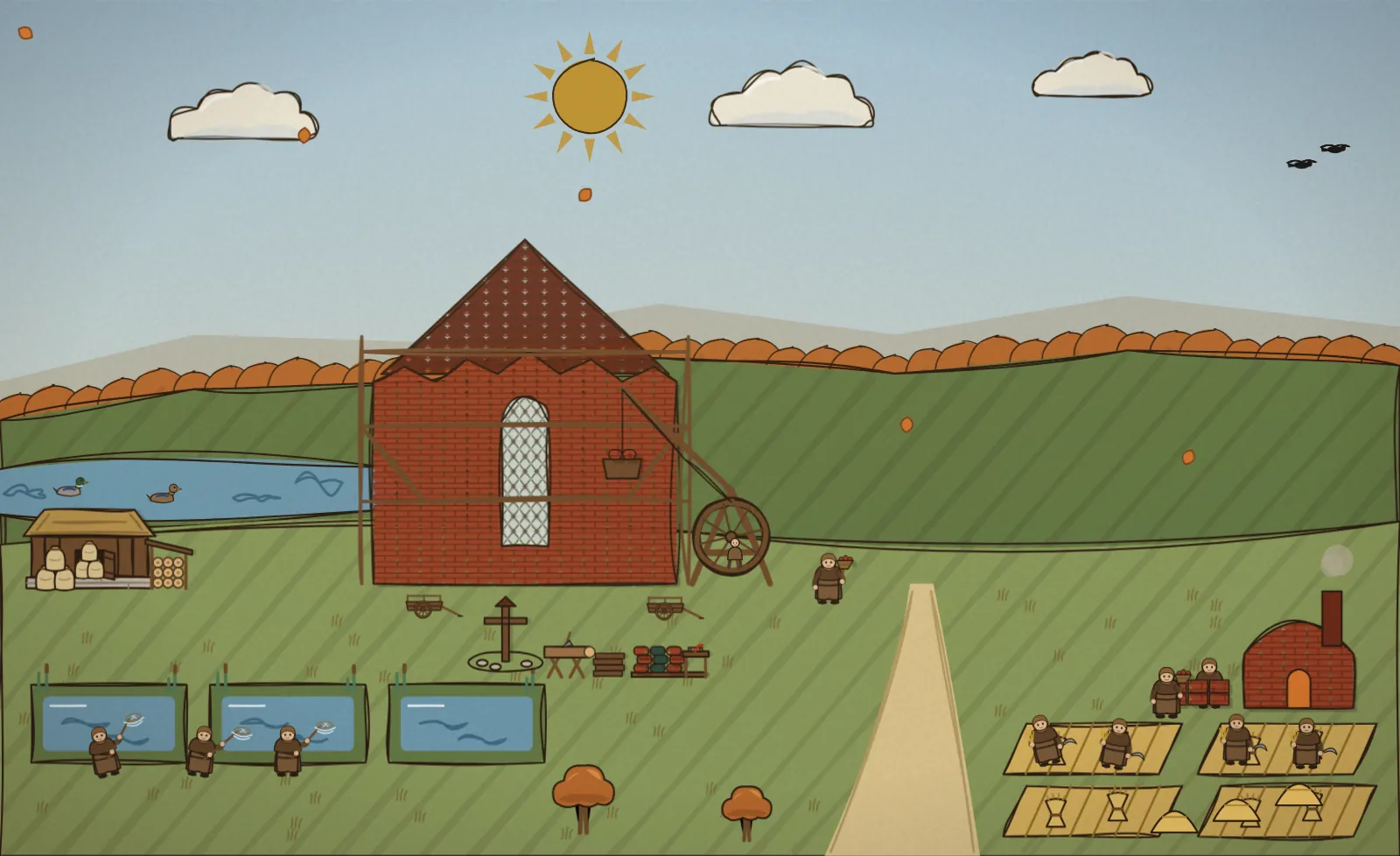
Chorin: an autumn afternoon

The goals of the era

  1. Move to Chorin

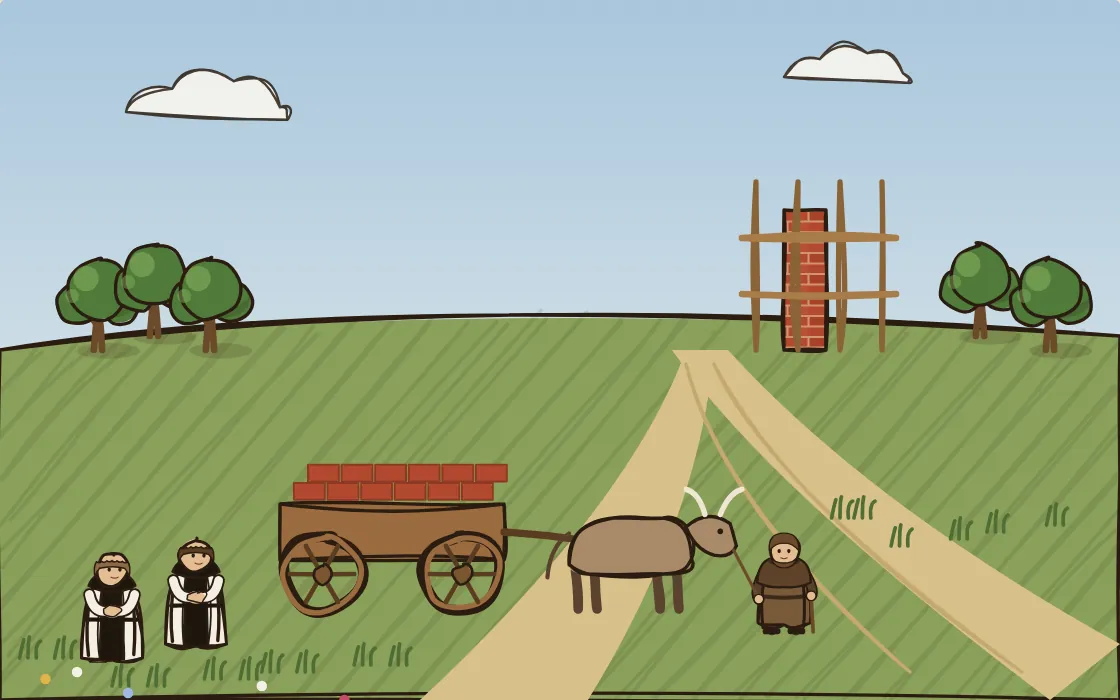
    The island will not serve for long: a charter of 1273 will speak of “many inconveniences”, and on 8 September 1273 the margraves will confirm the move to Chorin. Half of your bricks will travel with the brothers.

  2. The choir

    First stage of St Mary’s church: the choir in the east, where the brothers pray.

  3. The nave

    A three-aisled brick basilica. Cistercians built no bell towers, only a small turret on the roof ridge.

  4. The west front

    Building moved around the abbey courtyard and ended with the church’s west front around 1300.

Pages of the chronicle

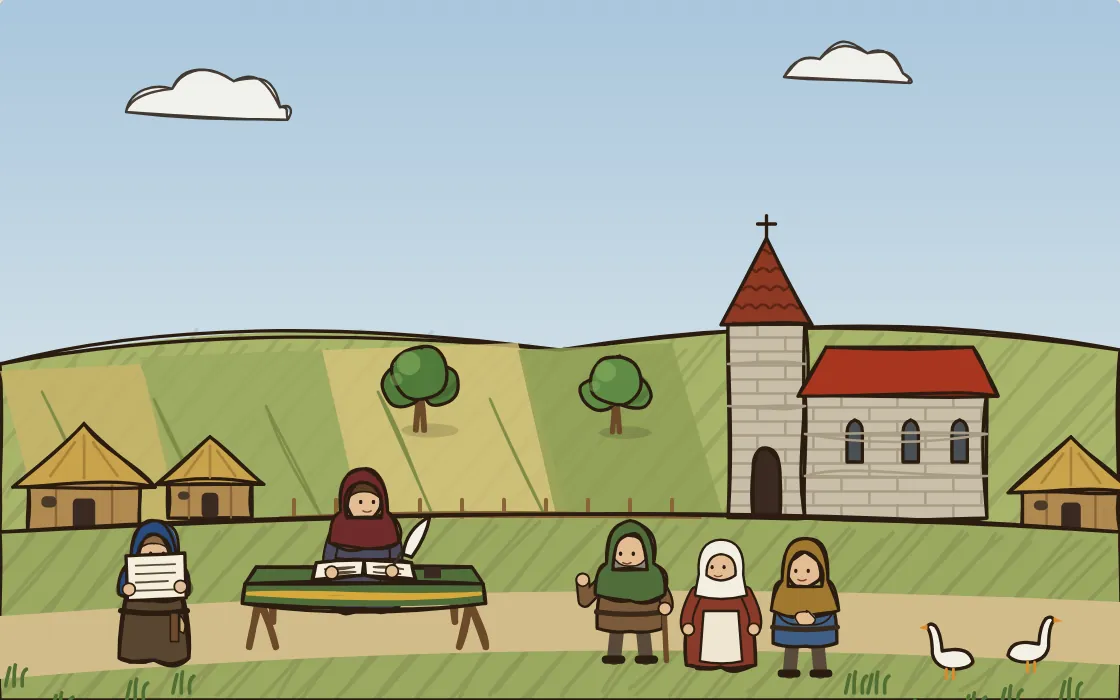
Prologue. A land of lakes and beeches

Prologue. A land of lakes and beeches

North-eastern Brandenburg, about an hour from Berlin. The glaciers of the last Ice Age left hills, hundreds of lakes and sandy plains here, later covered by beech and pine forests.

Today this is the Schorfheide-Chorin Biosphere Reserve, and nearby lie beech forests on UNESCO’s World Natural Heritage list. In the 13th century it was the frontier of the Ascanian lands, with Slavic and Pomeranian territory beyond.

You lead a community of Cistercian monks arriving here in 1258. Your task: to pray and to work, ora et labora, and to raise an abbey people will still talk about seven centuries later.

SourceBiosphärenreservat Schorfheide-Chorin; Klosterland e. V. (Faltblatt Chorin)
The Ascanians and the March of Brandenburg

The Ascanians and the March of Brandenburg

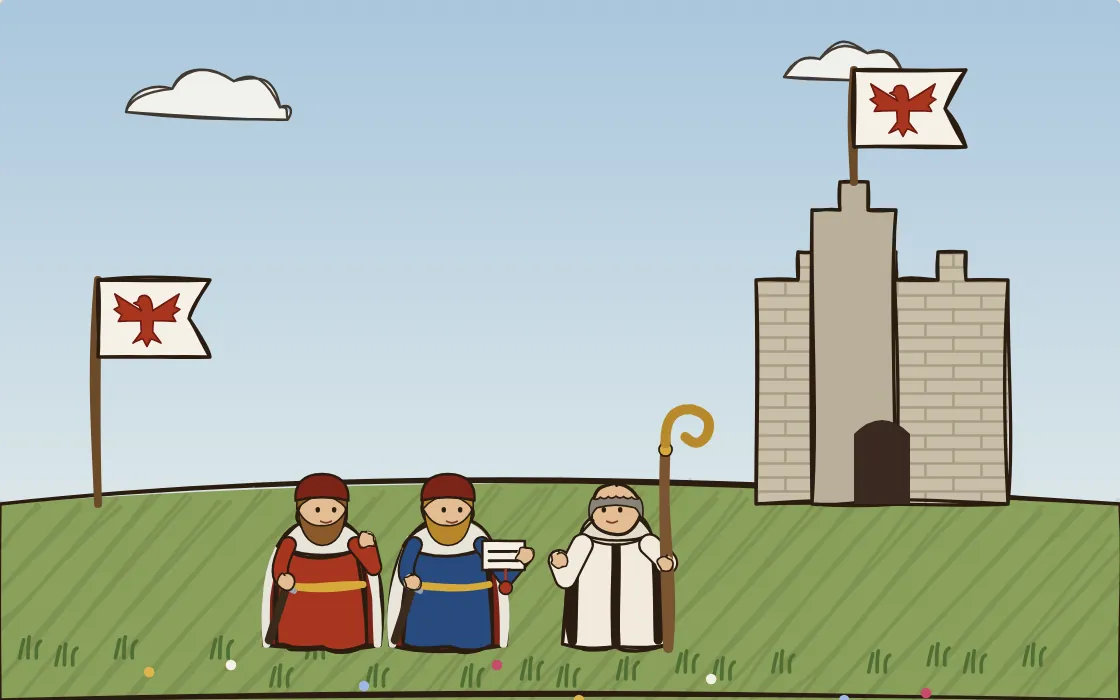
The March of Brandenburg was ruled by the House of Ascania. In the mid-13th century the brother margraves John I and Otto III governed the land together.

Monasteries were their mainstay: they opened up land, founded farms and secured power on the edge of Slavic territory. The abbey you are building was meant as a representative house and burial place of the Ascanians.

In 1258 the margraves gave Lehnin Abbey villages and lakes with the task of founding a new abbey on the larger island in Lake Parstein.

SourceA. F. Riedel, Codex diplomaticus Brandenburgensis A XIII (1857), Nr. V (2.9.1258); Klosterland e. V. (Faltblatt Chorin); D. Schumann, Markgräfliches Hauskloster, in: Offene Kirchen 2022 (Förderkreis Alte Kirchen Berlin-Brandenburg)
The white monks

The white monks

The Cistercian order was founded in 1098 at Cîteaux in Burgundy by monks who wanted to live more strictly by the Rule of St Benedict. They wore habits of undyed wool and were therefore called the white monks.

Cistercians settled far from towns, near water, and lived from their own labour. Their churches were meant to be plain: no bell towers, only a small turret on the roof ridge.

Abbeys spread like a family: a mother house founded daughter houses. For Mariensee, and so for Chorin, the mother house was Lehnin, itself an Ascanian foundation.

SourceBrandenburgisches Klosterbuch (2007); A. F. Riedel, Codex diplomaticus Brandenburgensis A XIII (1857), Nr. V

Mariensee island

Mariensee island

On 2 September 1258 the margraves ordered a Cistercian abbey to be founded on an island in Lake Parstein. It was called Mariensee, “Mary’s lake”. The former island of Pehlitzwerder is a peninsula today.

On the island stood a Slavic ring rampart with a later castle; the monastery was built beside it. Margrave John I was buried in the unfinished church of Mariensee; his remains were later moved to Chorin.

Of Mariensee, wall remains and foundations survive; when Theodor Fontane came, they stood only about two feet high.

SourceA. F. Riedel, Codex diplomaticus Brandenburgensis A XIII (1857), Nr. V; Kloster Chorin: Geschichte (kloster-chorin.org); D. Schumann, Markgräfliches Hauskloster, in: Offene Kirchen 2022 (Förderkreis Alte Kirchen Berlin-Brandenburg); Th. Fontane, Wanderungen durch die Mark Brandenburg, Bd. 3 (1873)

Lay brothers and granges

Lay brothers and granges

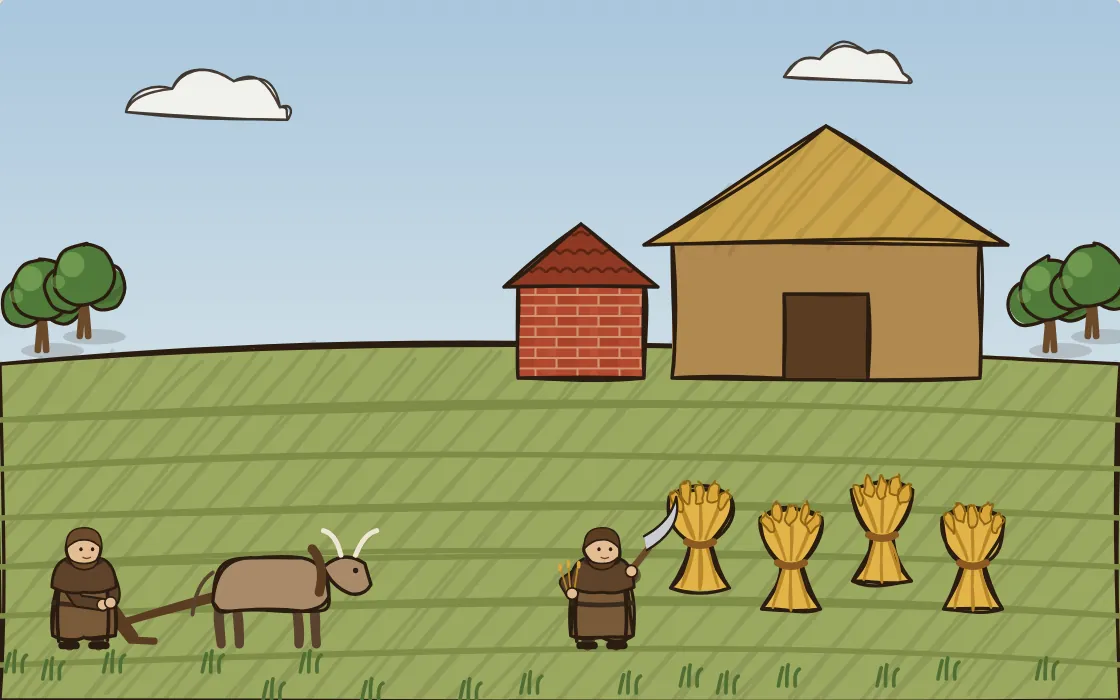
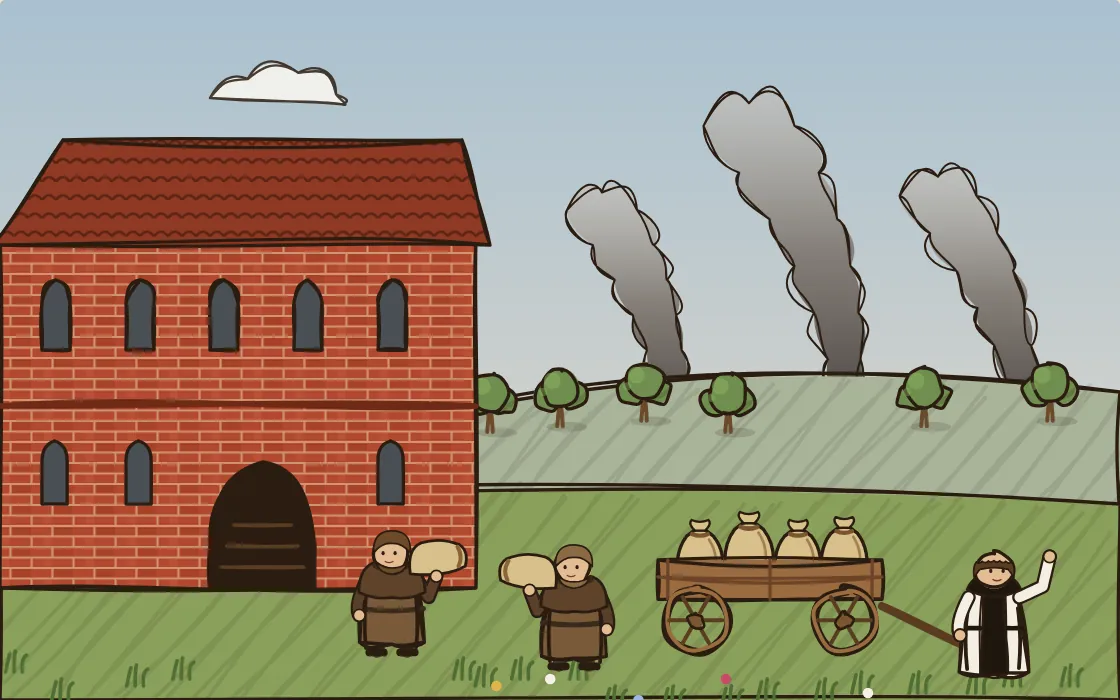
A Cistercian community was made up of two groups. Choir monks devoted more time to prayer, while lay brothers, mostly of peasant origin, did most of the farm work.

The order’s outlying farms were called granges. Lay brothers lived there for weeks, working the fields and tending the livestock. At Chorin a separate west wing, the last of the ranges to be built, was raised for them.

This system made the Cistercians renowned farmers of medieval Europe.

SourceMuseum Eberswalde (Th. Sander); Brandenburgisches Klosterbuch (2007)

The move to Chorin

The move to Chorin

The island proved unsuitable: the charter of 1273 speaks of “many inconveniences”. The move to the Choriner See, today’s Amtssee, was decided around 1266; work on the new church is dated 1272 or 1273, depending on the source.

On 8 September 1273 the margraves officially confirmed the move, and the abbey took the name Chorin. The new site already had a mill, granted to the abbey in 1258, and lay by a lake closer to Eberswalde and Angermünde.

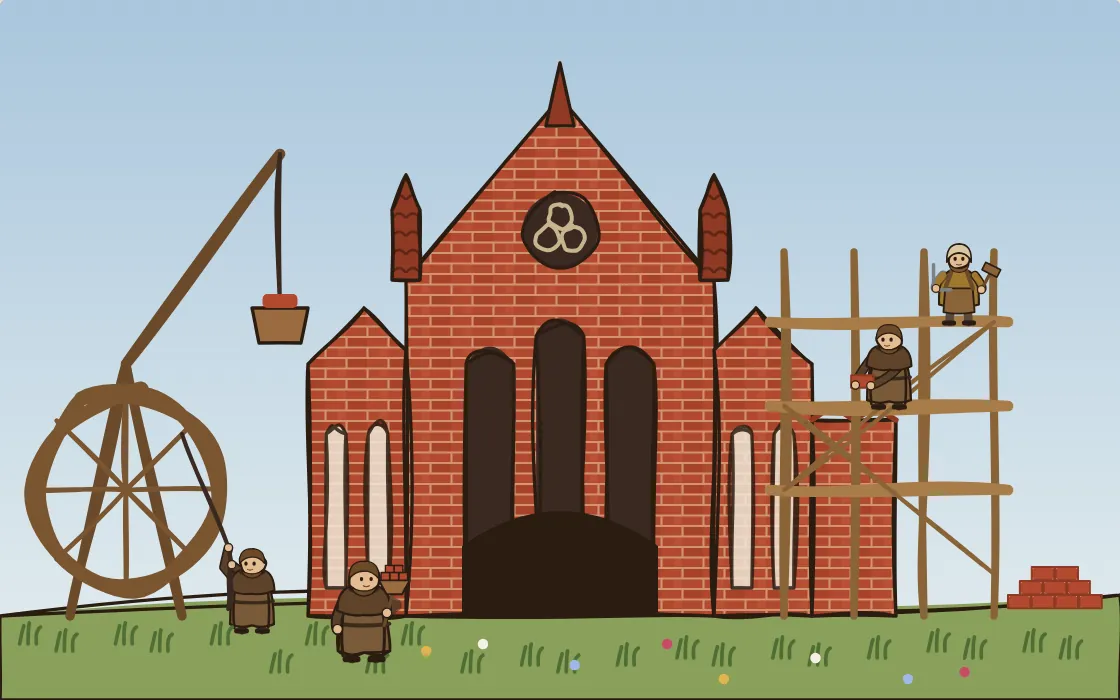
The abbey was built clockwise around the courtyard. The church’s west front was completed last, around 1300.

Even earlier, by a charter of 1 April 1272, the margraves Otto and Albrecht gave St Mary’s monastery at Chorin nine hides of land at Woltersdorf. Later the remains of Margrave John I were brought here, and Chorin became the burial place of his line of the Ascanians. On the former island, today the Pehlitzwerder peninsula, remains of the walls of Mariensee can still be seen; Theodor Fontane visited them and described them in his “Wanderings through the Mark Brandenburg”.

SourceA. F. Riedel, Codex diplomaticus Brandenburgensis A XIII (1857), Nr. V (2.9.1258), XIV (1.4.1272), XVII (8.9.1273); Museum Eberswalde; Th. Fontane, Wanderungen durch die Mark Brandenburg, Bd. 3 (1873); Kloster Chorin: Geschichte (kloster-chorin.org); D. Schumann, Markgräfliches Hauskloster, in: Offene Kirchen 2022 (Förderkreis Alte Kirchen Berlin-Brandenburg)

Brick Gothic

The plains of northern Germany had almost no building stone, only fieldstone. So people built with brick, and a style of its own arose: Brick Gothic.

Chorin is one of its most important monuments. Craftsmen shaped moulded bricks for friezes and individually designed corbels, and cut plant motifs into the raw clay.

The blind niches you see on the facades belong to the same art.

SourceKlosterland e. V. (Faltblatt Chorin); Kloster Chorin: Geschichte (kloster-chorin.org); D. Schumann, Markgräfliches Hauskloster, in: Offene Kirchen 2022 (Förderkreis Alte Kirchen Berlin-Brandenburg); G. Kiesow, Backstein ist nicht gleich Backstein, in: Monumente 3/2009

The brickworks

The brickworks

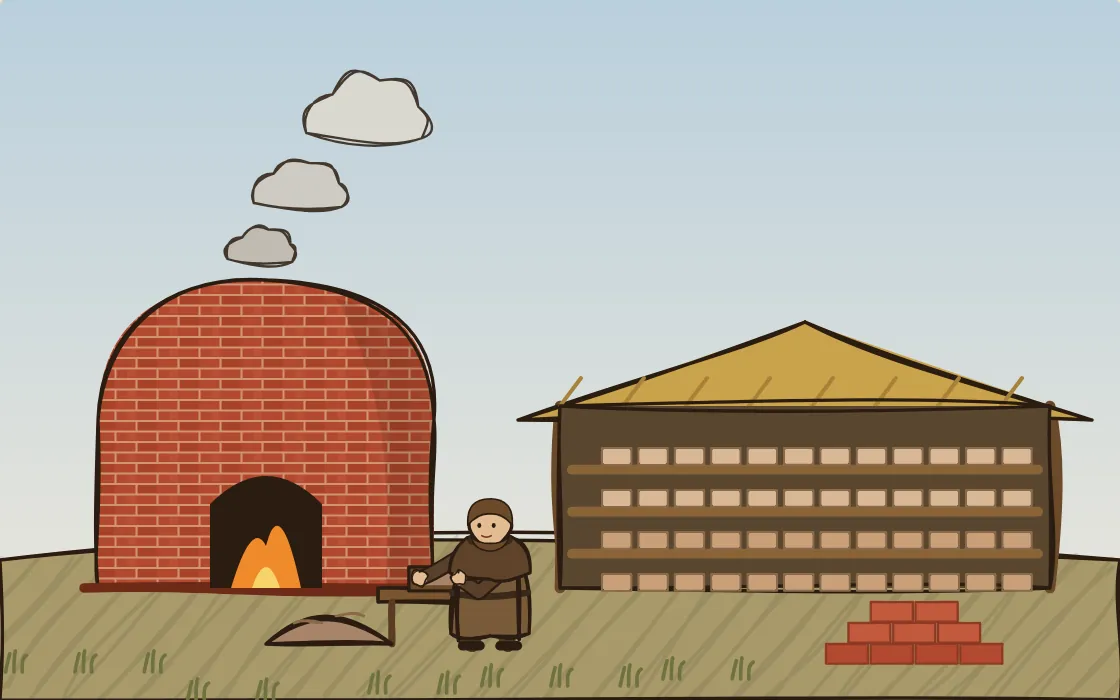
Clay was dug nearby, kneaded with water and sand and shaped in wooden moulds. The raw bricks dried for weeks and were then fired in field kilns. Often only about a third of a firing could be used.

Medieval bricks of the so-called monastery format were larger than modern ones, about 28 centimetres long. Moulded bricks were shaped for friezes, ribs and window frames, and in Brick Gothic some bricks were glazed so that walls shone with dark bands.

In winter far fewer hands worked on a building site, so brickmaking too had its season, just as in the game, where bricks come faster in summer.

SourceKloster Chorin: Geschichte (kloster-chorin.org); D. Schumann, Markgräfliches Hauskloster, in: Offene Kirchen 2022 (Förderkreis Alte Kirchen Berlin-Brandenburg); O. Stiehl, Backstein, in: Reallexikon zur Deutschen Kunstgeschichte, Bd. I (1937), Sp. 1340–1345; G. Kiesow, Backstein ist nicht gleich Backstein, in: Monumente 3/2009; Hochschule Neubrandenburg: Ziegeleien allgemein (hs-nb.de); G. Binding, Bauwissen im Früh- und Hochmittelalter, in: Wissensgeschichte der Architektur, Bd. III, Berlin 2014

A monk’s day

A monk’s day

A Cistercian’s day was divided between prayer, work and reading. The monks rose at night for Vigils, in winter long before dawn. Little speech was allowed: silence reigned in the dormitory, the refectory and the cloister.

From Easter to mid-September they usually ate twice a day (in summer often only once on Wednesdays and Fridays); the rest of the year once, and in Lent not until evening. Bread, vegetables, pulses and fish were the staples, as the Rule restricted meat. During meals one brother read aloud while the others listened in silence.

Between the prayers came work in the fields and workshops and “divine reading”, a slow, thoughtful reading of Scripture.

SourceRegula Benedicti, cap. 6, 8, 16, 38–42, 48

The Liturgy of the Hours

The Liturgy of the Hours

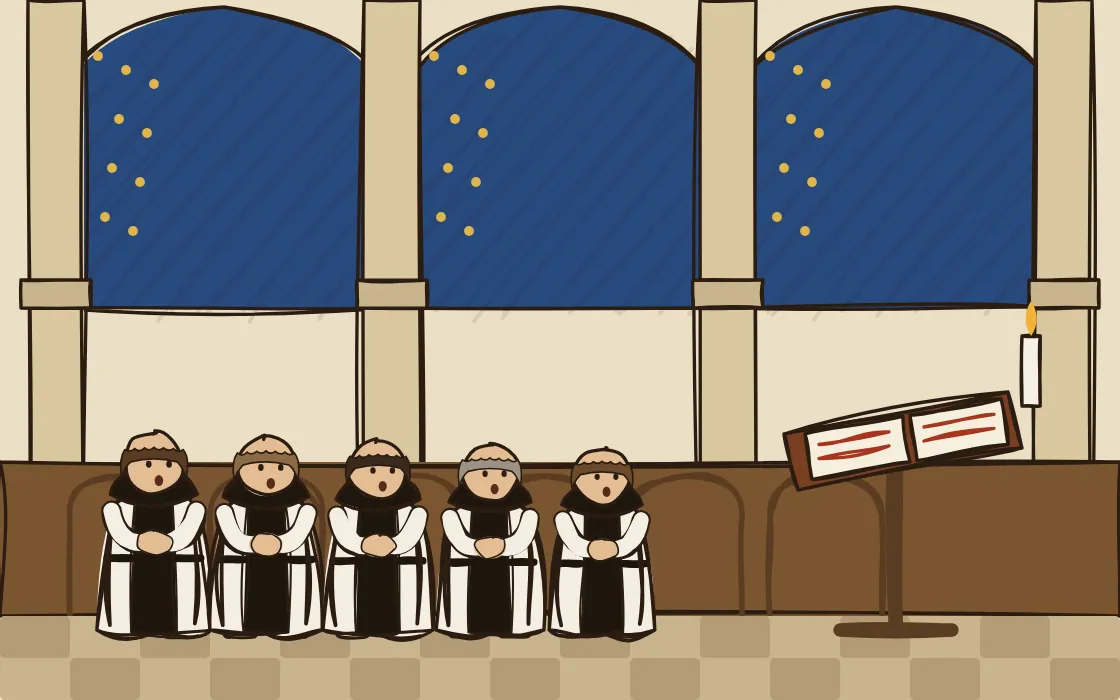
The Rule of St Benedict divided a monk’s day by prayer: Vigils at night, Lauds at dawn, then Prime, Terce, Sext and None, Vespers, and Compline before sleep.

The game uses four of them, but in your real time: Lauds at 6:00, Sext at 12:00, Vespers at 18:00 and Compline at 21:00. During these hours Faith is doubled.

SourceRegula Benedicti, cap. 8–18

Guests and pilgrims

Guests and pilgrims

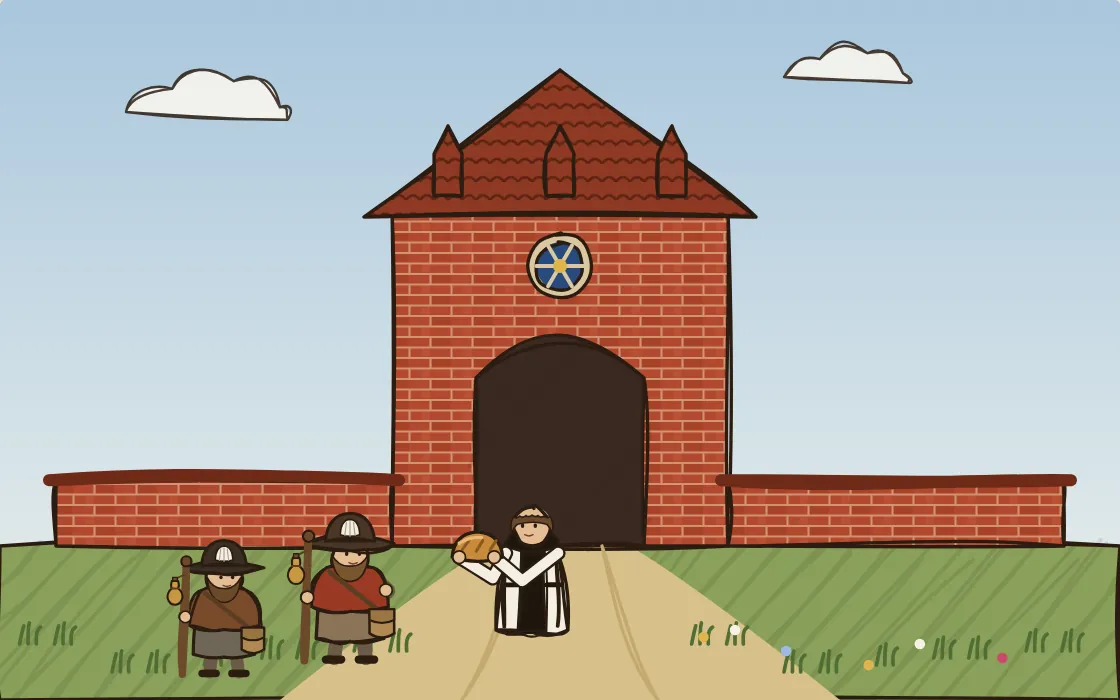
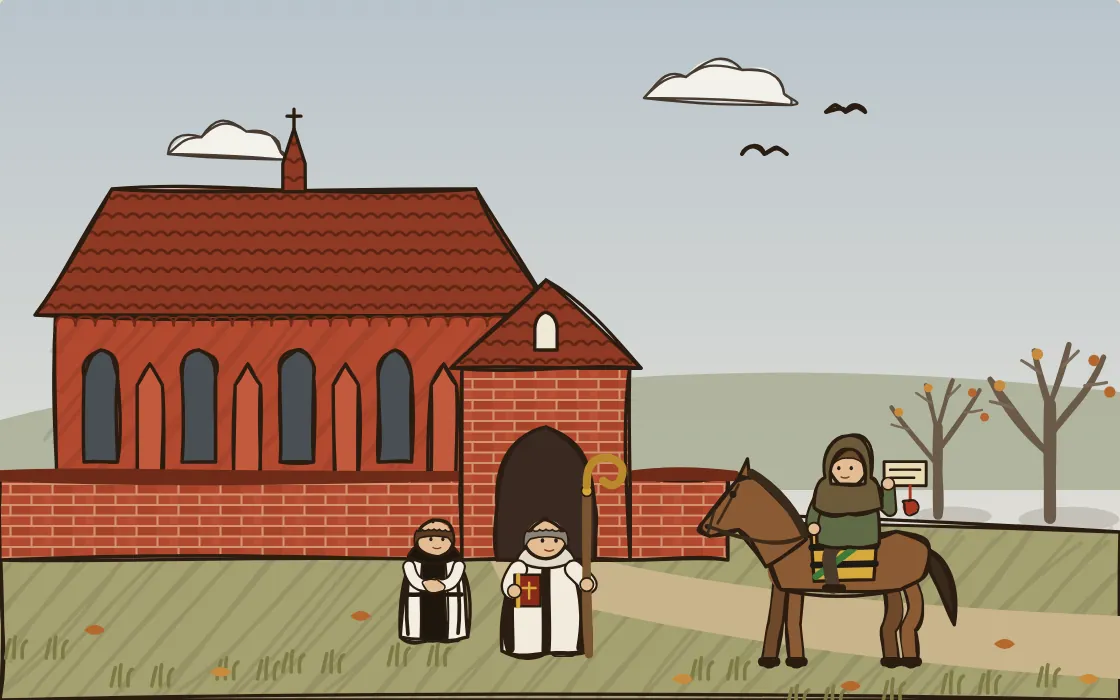
The Rule of St Benedict commands that every guest be received as Christ himself. So abbeys kept guesthouses, and travellers could count on bread and a bed.

Pilgrims are easy to spot by their broad hat, staff and scallop shell, the sign of the pilgrimage to Santiago de Compostela. In the game they bring alms or a blessing.

SourceRegula Benedicti, cap. 53

The west front

The west front

Chorin’s three-aisled basilica received its famous west front around 1300. The art historian Georg Dehio called the church the most important and noblest work of Early Gothic in north German brick architecture.

In the west wing, fragments of medieval wall paintings from around 1300 survive, though largely as a copy made during the restoration of 1885. The Cistercian community lived at Chorin for about 270 years.

SourceG. Dehio, Handbuch der deutschen Kunstdenkmäler, Bd. 2 (1906); Museum Eberswalde; Klosterland e. V. (Faltblatt Chorin); J. Raue, Ein Mittelalterbild im Rahmen von Ordnung, Pflicht und Schönheit, in: N.-J. von Möllendorff, V. Ummenhofer (Hg.), Mittelalterbilder und Denkmalpflege, Bamberg 2023, S. 241–268

People of the era

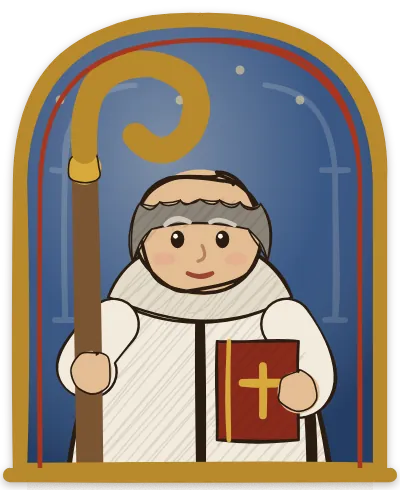
The abbot
The abbot
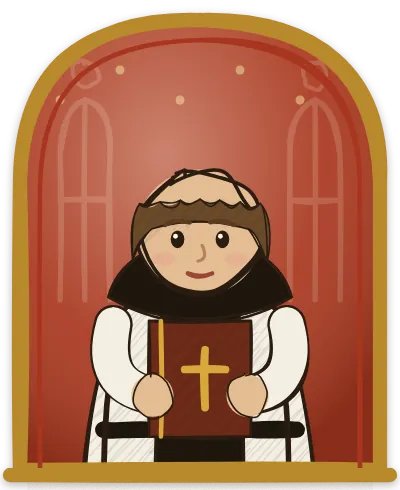
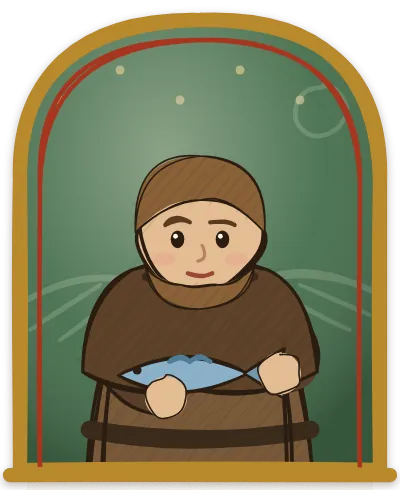
A choir monk
A choir monk
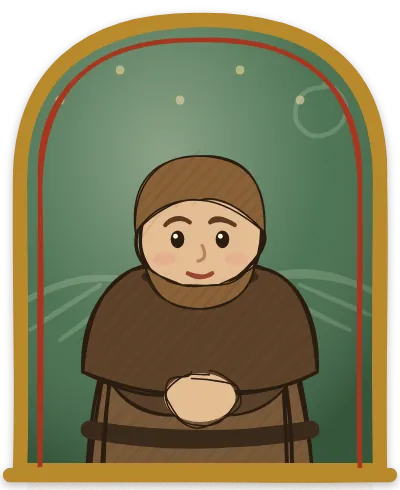
A lay brother
A lay brother
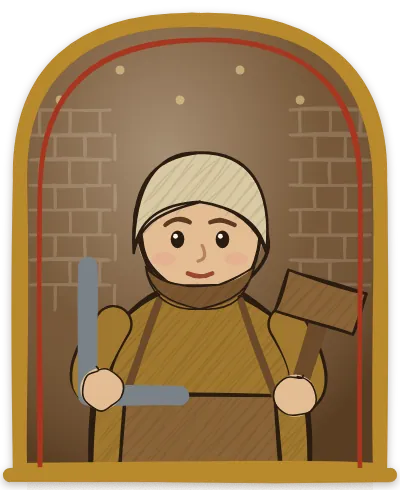
The master builder
The master builder
A margrave of the Ascanian house
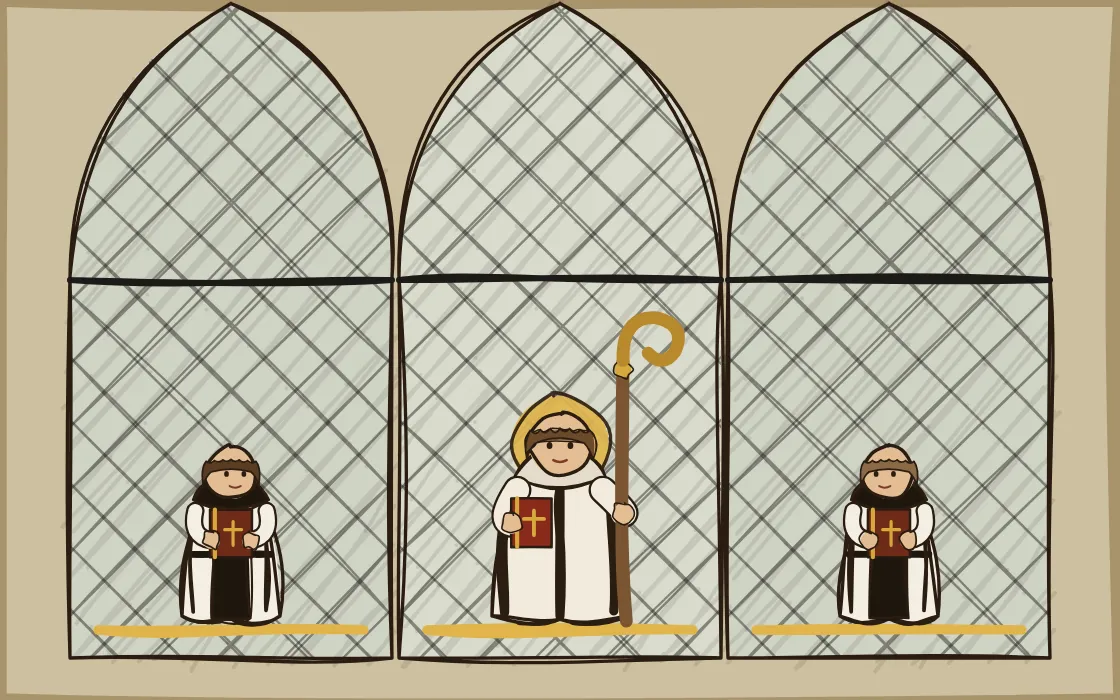
The abbot, a choir monk, a lay brother, a master mason, a village woman with her eggs, two pilgrims and the margrave
Era II

The heyday, 14th–15th centuries

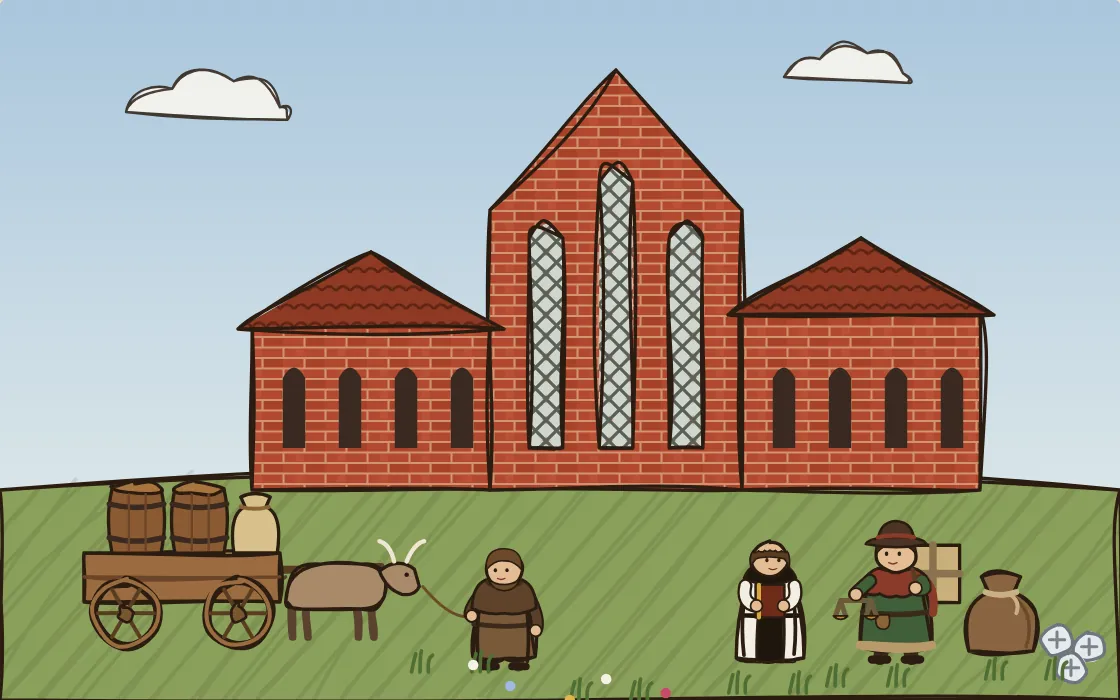
The abbey at its height: villages and lands, mills and fish ponds, trade on the Oder and a hall for princely guests. The history of the Mark Brandenburg reaches its gate.

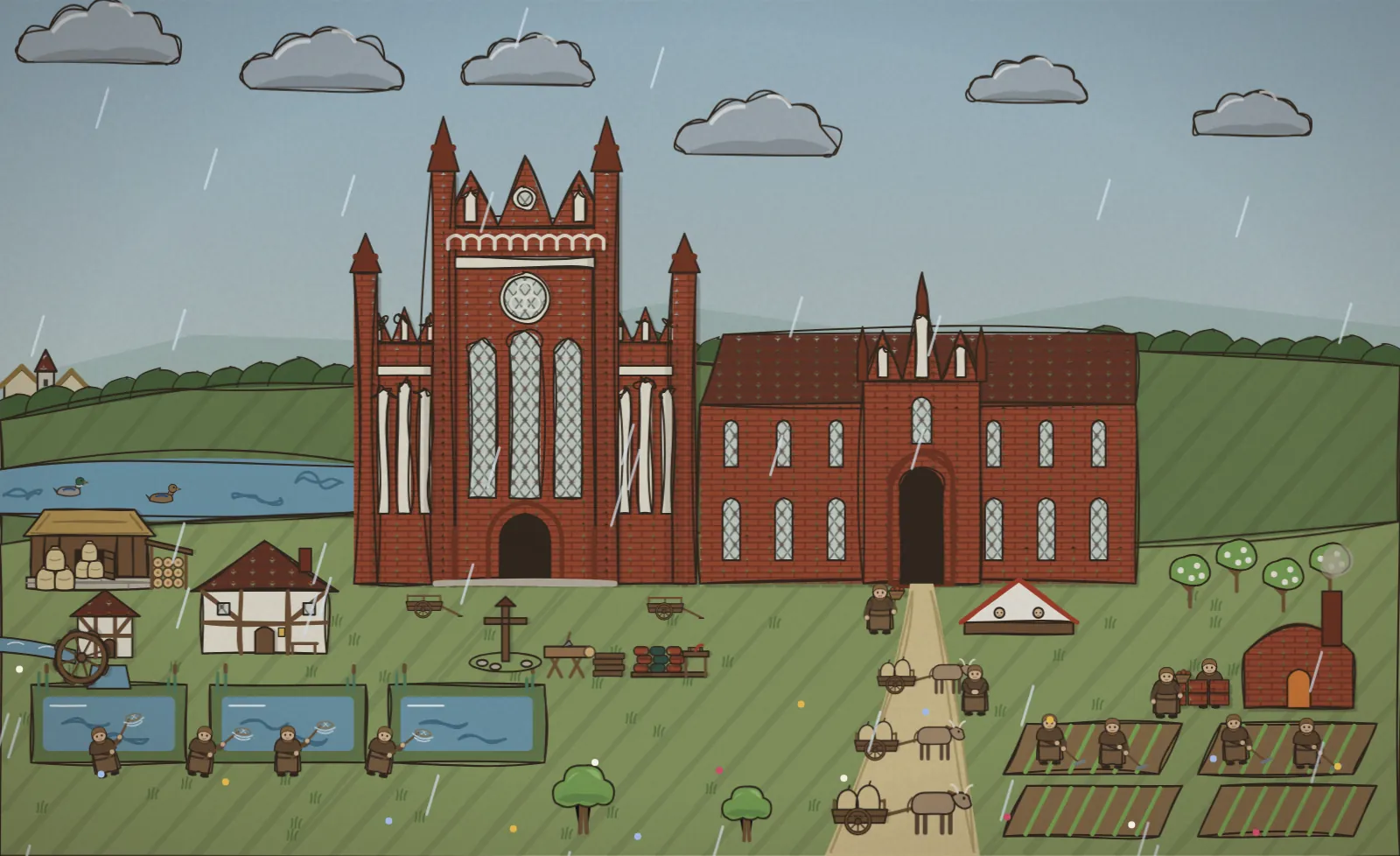
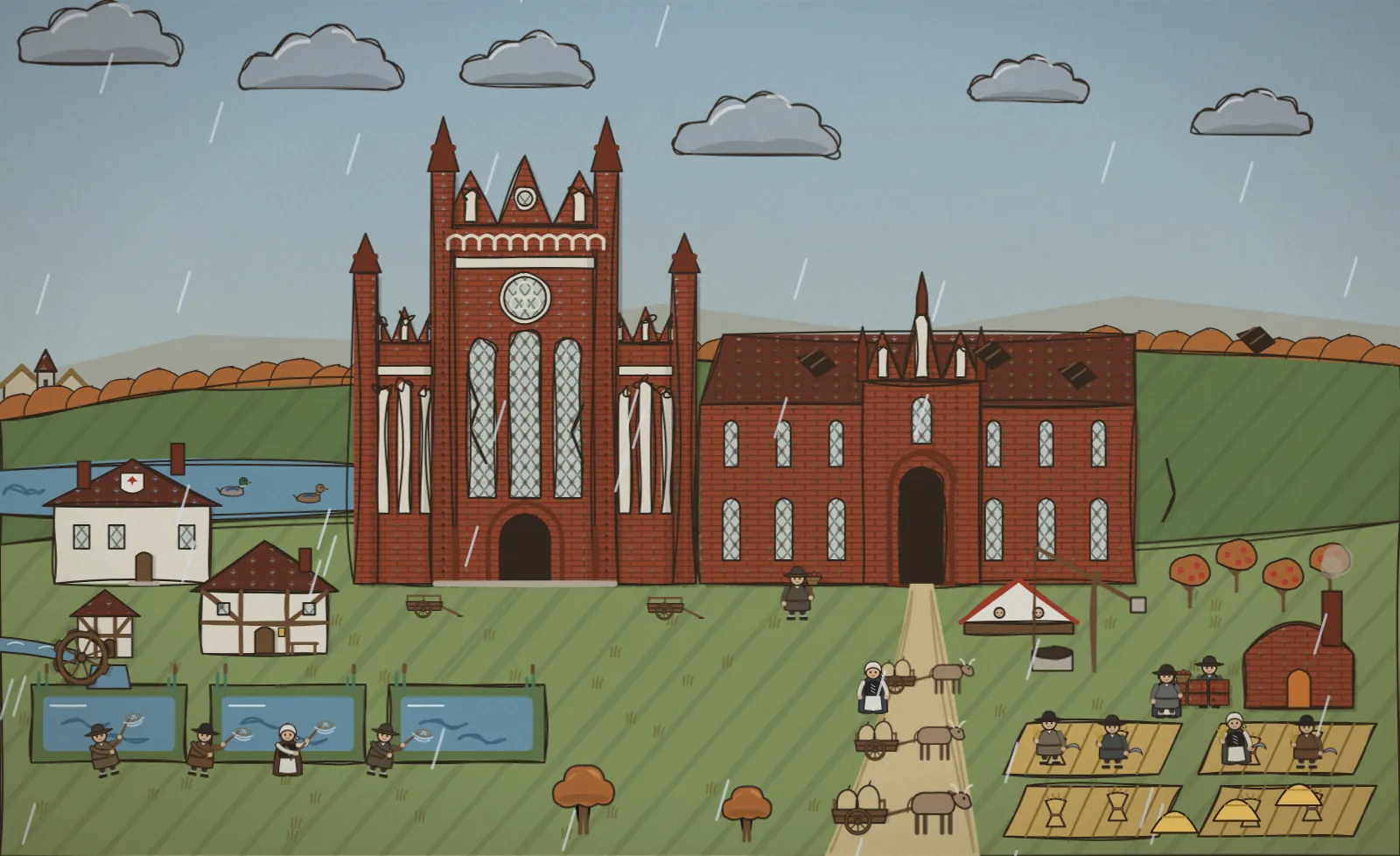
Spring rain over the abbey
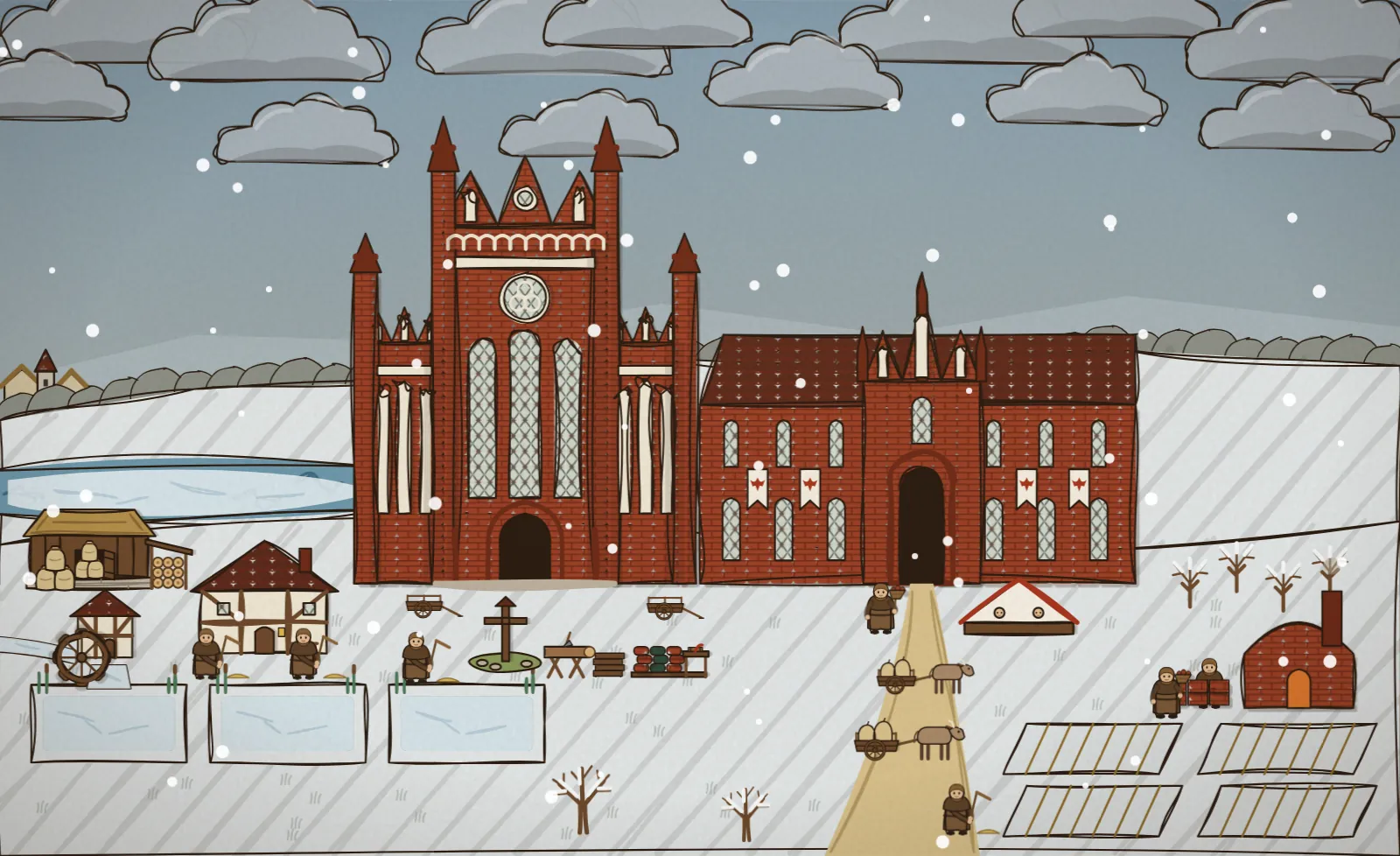
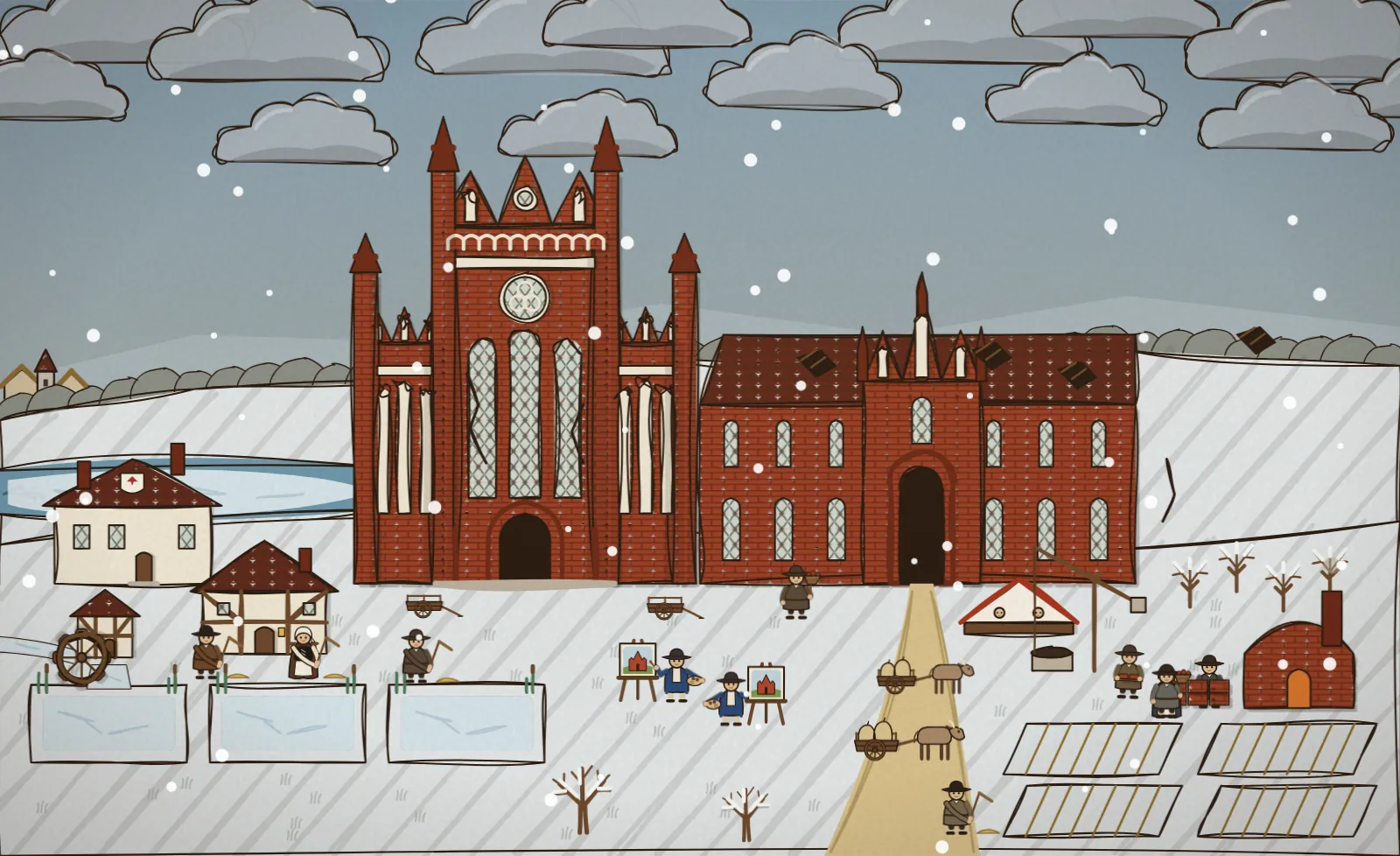
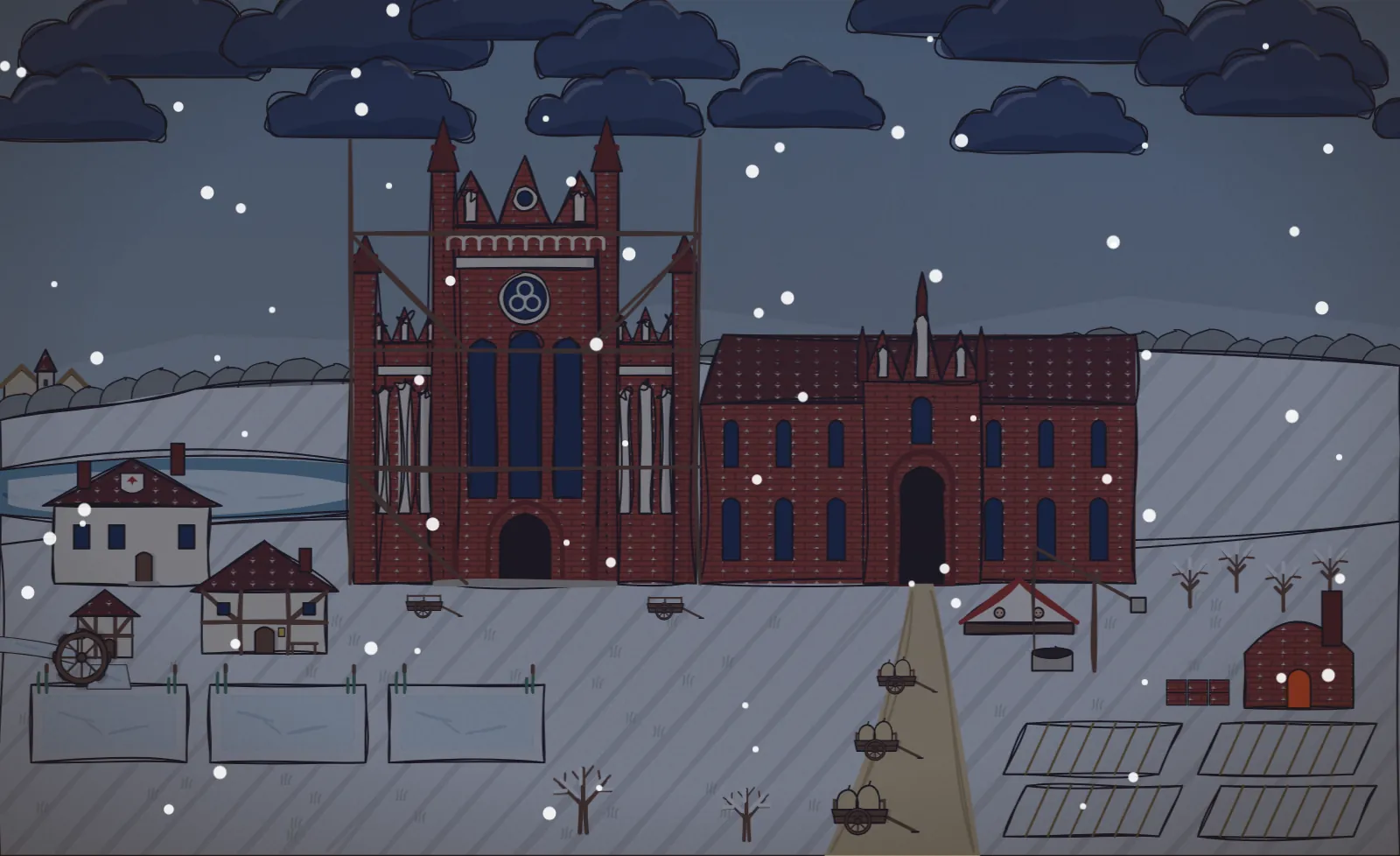
Winter: snow on the roofs, ice on the lake
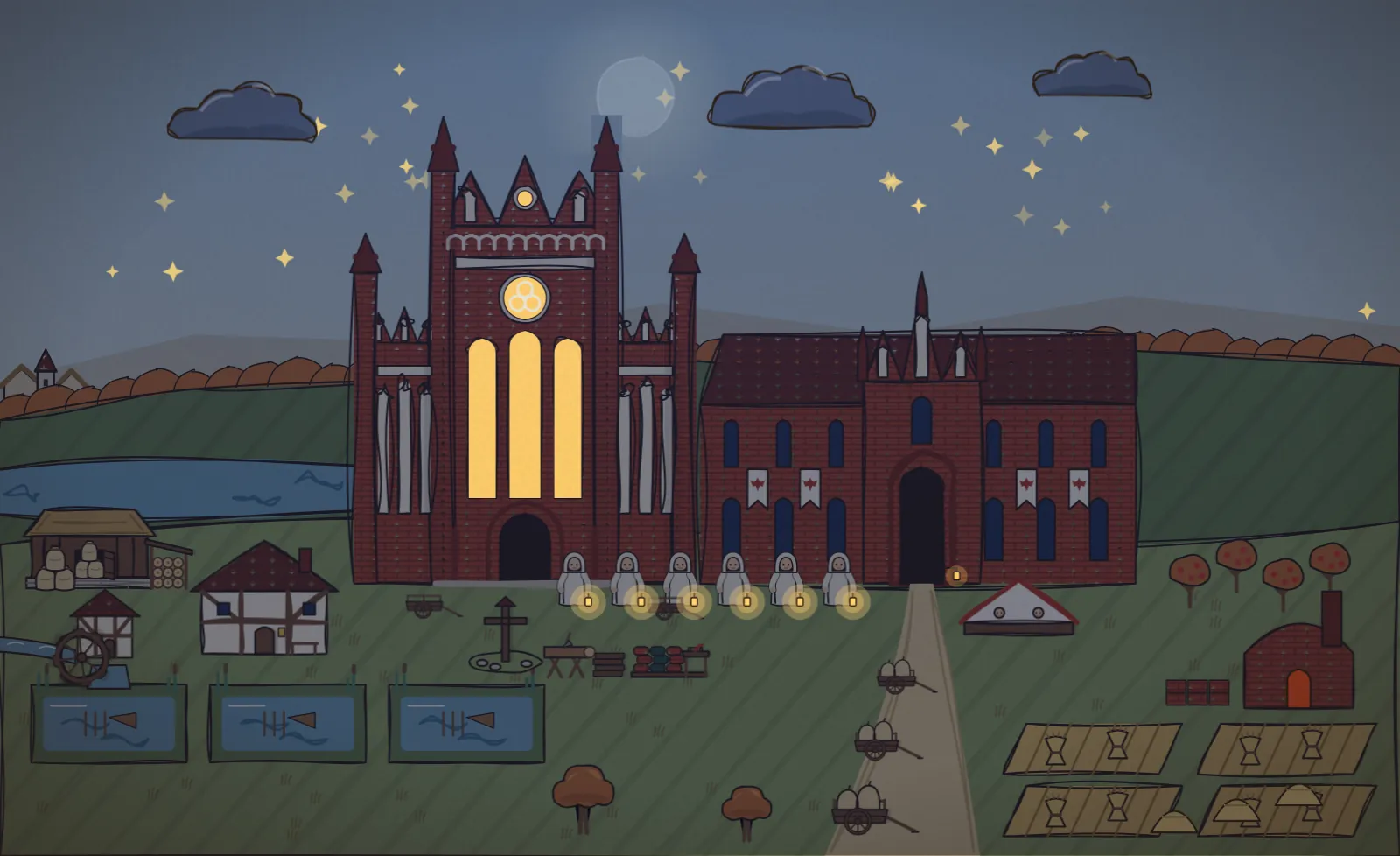
An autumn night: the brothers walk to the Vigils with lanterns

The goals of the era

  1. Buy the village of Ziethen

    The abbey kept expanding its lands. In 1320 it bought Groß Ziethen from the knight Redekin; Prince Henry of Mecklenburg confirmed the sale.

  2. The Fürstensaal

    In the west wing lies the Fürstensaal, the princes’ hall. Fragments of its wall paintings from around 1300 survive, largely as a copy made in 1885. Keep the hall worthy of its guests.

  3. The estates at their height

    In the 14th and 15th centuries the abbey kept enlarging its estates; at their height its core lands stretched about 40 by 40 kilometres. Gather a treasury worthy of them.

Pages of the chronicle

Water for mills and ponds

Water for mills and ponds

The little river Ragöse flows out of the Amtssee, but its water was not enough for the abbey’s mills and household. So the monks dug the Nettelgraben, a channel several kilometres long that brought more water from the Lake Parstein basin to the abbey, its ponds and its mills. Around 1400 the abbey ran eleven water mills.

Fish was an important part of the abbey’s diet, because the Rule restricted meat. The Cistercians therefore dammed ponds, and the margraves granted the abbey fishing rights, among them at Oderberg.

Of the abbey’s service buildings, the ruined mill survives, and so does the brewhouse itself, which now houses the exhibition “Karl Friedrich Schinkel and Chorin”.

SourceEigenbetrieb Kloster Chorin: 3 kleine Rundgänge – Das Kloster Chorin in seiner Landschaft (Faltblatt, 2019); A. F. Riedel, Codex diplomaticus Brandenburgensis A XIII (1857), Nr. XXX

The abbey’s lands

The abbey’s lands

The Ascanians endowed the abbey generously: islands in Lake Parstein, the villages of Pehlitz, Plawe, Brodowin and Chorin with their lakes, the hospital at Oderberg and the mill on the Ragöse.

Later the abbey bought or received further villages, such as Ziethen and Briest. At their height its core lands stretched about 40 by 40 kilometres.

For the site by the lake the abbey exchanged land with the Wendish village of Ragöse, which received 32 hides in Parstein.

SourceA. F. Riedel, Codex diplomaticus Brandenburgensis A XIII (1857), Nr. V (2.9.1258), XX (25.9.1275), XXV (27.6.1277); Klosterland e. V. (Faltblatt Chorin); Kloster Chorin: Geschichte (kloster-chorin.org)

The abbey’s estates

The abbey’s estates

Even in the 13th century the abbey added to its lands: in 1275 the margraves Otto and Albrecht sold it the village of Ziethen, and in 1277 it received Briest as a gift. In 1320 Prince Henry of Mecklenburg confirmed its purchase of Groß Ziethen from the knight Redekin. In the 14th and 15th centuries the abbey kept enlarging its estates.

But in 1542, a few years after the Reformation reached Brandenburg, the abbey will be secularised. The next era will tell that story.

SourceA. F. Riedel, Codex diplomaticus Brandenburgensis A XIII (1857), Nr. XX, XXV, LV; Klosterland e. V. (Faltblatt Chorin); J. Raue, Ein Mittelalterbild im Rahmen von Ordnung, Pflicht und Schönheit, in: N.-J. von Möllendorff, V. Ummenhofer (Hg.), Mittelalterbilder und Denkmalpflege, Bamberg 2023, S. 241–268

The end of the Ascanians
1320

The end of the Ascanians

Margrave Waldemar died in 1319 and was buried at Chorin. A year later, in 1320, the Brandenburg line of the Ascanians died out, and the Mark was left without a margrave.

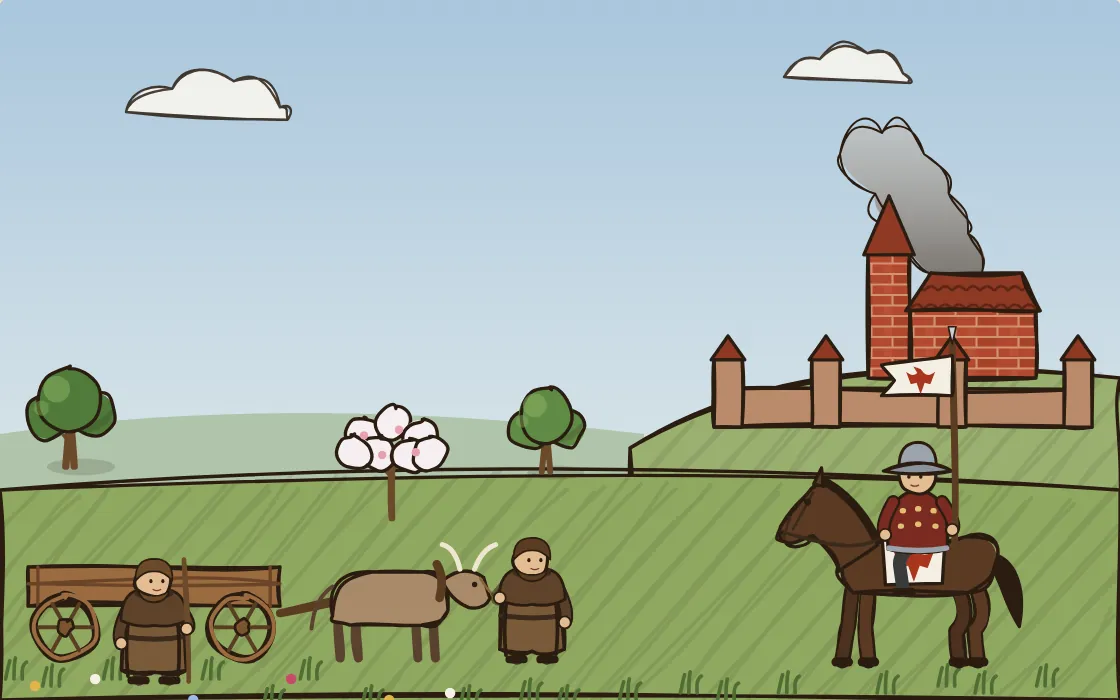
The abbeys the Ascanians had founded and endowed had to look for new protectors. On 30 November 1320 Duke Rudolf of Saxony took Chorin under his protection.

SourceA. F. Riedel, Codex diplomaticus Brandenburgensis A XIII (1857), regest of 30.11.1320; ADB 40 (1896) 677–687

The man who called himself Waldemar
1348

The man who called himself Waldemar

In 1348 a man came forward who said he was Margrave Waldemar, home from a long pilgrimage, though Waldemar had been buried at Chorin in 1319.

Many towns and lords of the Mark accepted him, but in 1350 he was declared an impostor. Who he really was, the sources do not say for certain.

SourceNDB 27 (2020) 294–295; ADB 40 (1896) 677–687

The Landbook of 1375
1375

The Landbook of 1375

In 1373 Emperor Charles IV bought the Mark Brandenburg. To know its revenues, he had a register of its dues and services drawn up, called at the time a Landbook.

Following a list of questions, the rights and dues of almost every village of the Teltow, Havelland, Zauche, Barnim and Uckermark were recorded on the spot. The result did not please the emperor: most of the ruler’s revenues had long been sold.

SourceF. Escher, Die Mark Brandenburg unter den frühen Hohenzollern. Eine historische Einführung, in: P. Knüvener, D. Schumann (Hg.), Die Mark Brandenburg unter den frühen Hohenzollern, Berlin 2015, S. 17–24

War over the Uckermark
1420

War over the Uckermark

In 1420 the margrave and the dukes of Pomerania fought at Angermünde, not far from Chorin.

Their wars over the Uckermark went on until 1427.

SourceStadt Angermünde, Stadtgeschichte; Encyclopaedia Britannica (1911)

The Hussites near Eberswalde
1432

The Hussites near Eberswalde

In April 1432 a Hussite army marched into the Mark Brandenburg. The northernmost place it is known from the sources to have reached is Gersdorf near Eberswalde.

Bernau held out against it on 23 April.

SourceU. Tresp, Hussiteneinfall in die Mark Brandenburg 1432, brandenburgikon (2018)

People of the era

A choir monk at his writing
A lay brother with a carp
A merchant of Oderberg
A pilgrim
A pilgrim
A village woman with her jug
A choir monk, villagers, a merchant of Oderberg, a noble traveller and his servant, the rider of 1320 and the messenger of the levy
Era III

Secularisation, 1542–1815

After the Reformation, in 1542, the abbey becomes a state estate. The monks are gone; stables and storehouses lean against the church, and the walls begin to decay.

The state estate on a summer afternoon
Winter on the estate
Autumn rain over the estate

The goals of the era

  1. Set up the state estate

    In 1542 the abbey was secularised and turned into a state estate. The convent was no longer complete; the buildings are being adapted for farming.

  2. Preserve the ruin until 1797

    The buildings are decaying. Keep the monument at 40% or better until the architect David Gilly sees the ruin as a picturesque spot.

Pages of the chronicle

The end of the abbey

The end of the abbey

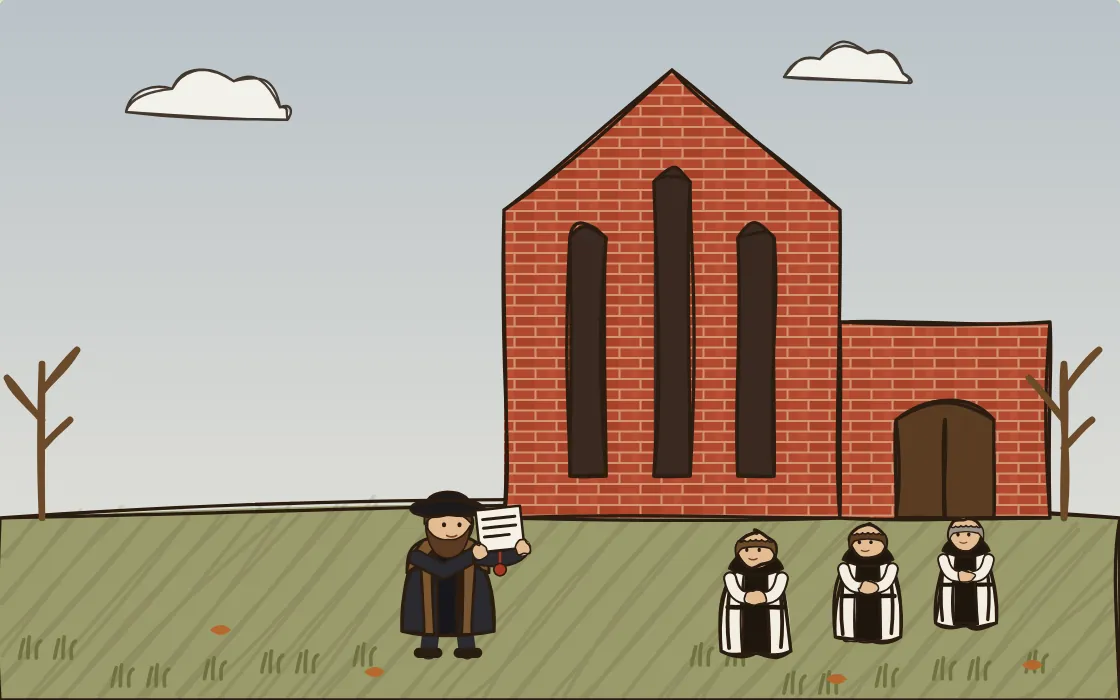
In 1542, a few years after the Reformation reached Brandenburg, the abbey was secularised and turned into a state estate. Its buildings began to decay.

In 1797 the architect David Gilly saw the ruin on the Amtssee as a picturesque spot, and for that very reason one worth preserving. Stables and storehouses had been built against the east side of the church.

SourceMuseum Eberswalde; Klosterland e. V.; Kloster Chorin: Geschichte (kloster-chorin.org)

Plague in Prenzlau
1710

Plague in Prenzlau

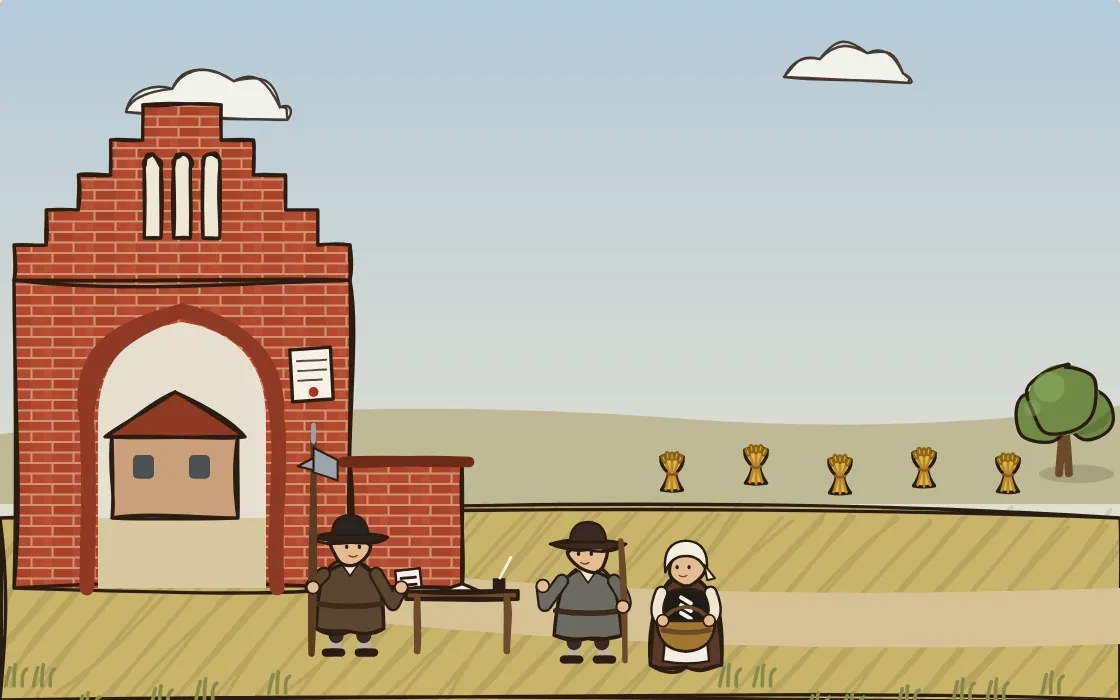
From 1709 to 1711 the plague went through the Uckermark. In August 1710 it reached Prenzlau.

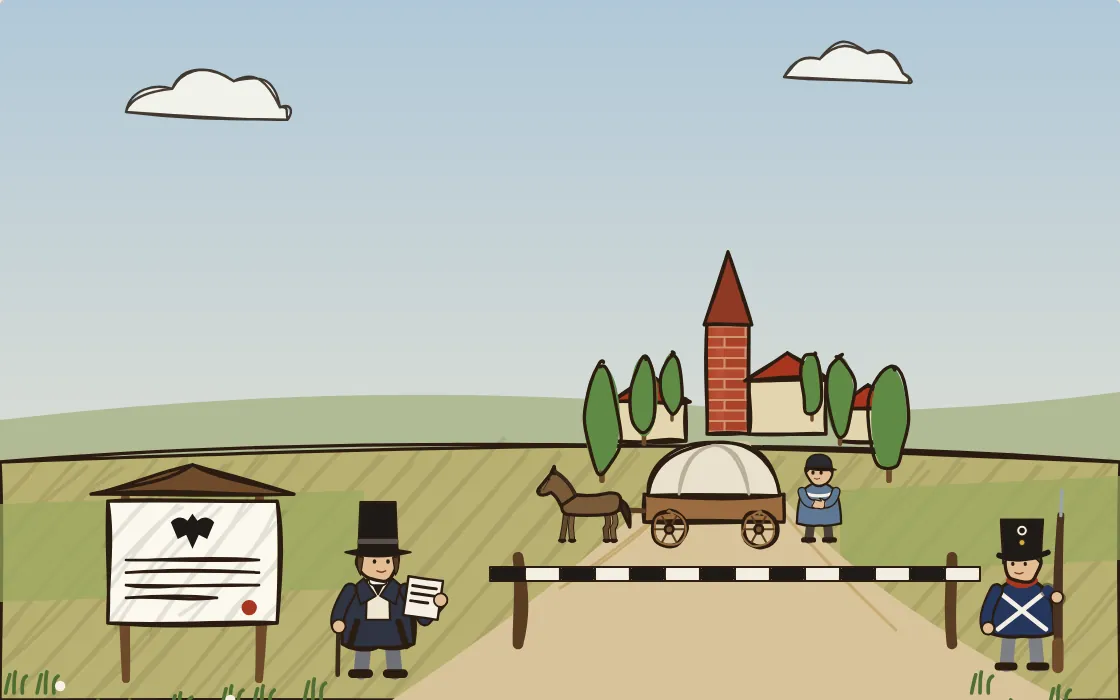
The authorities ordered quarantine and health passes: travellers had to show that they came from a place free of the plague.

SourceF. Göse, Große Pest (1708–11), brandenburgikon (2020)

The draining of the Oderbruch
1747–1753

The draining of the Oderbruch

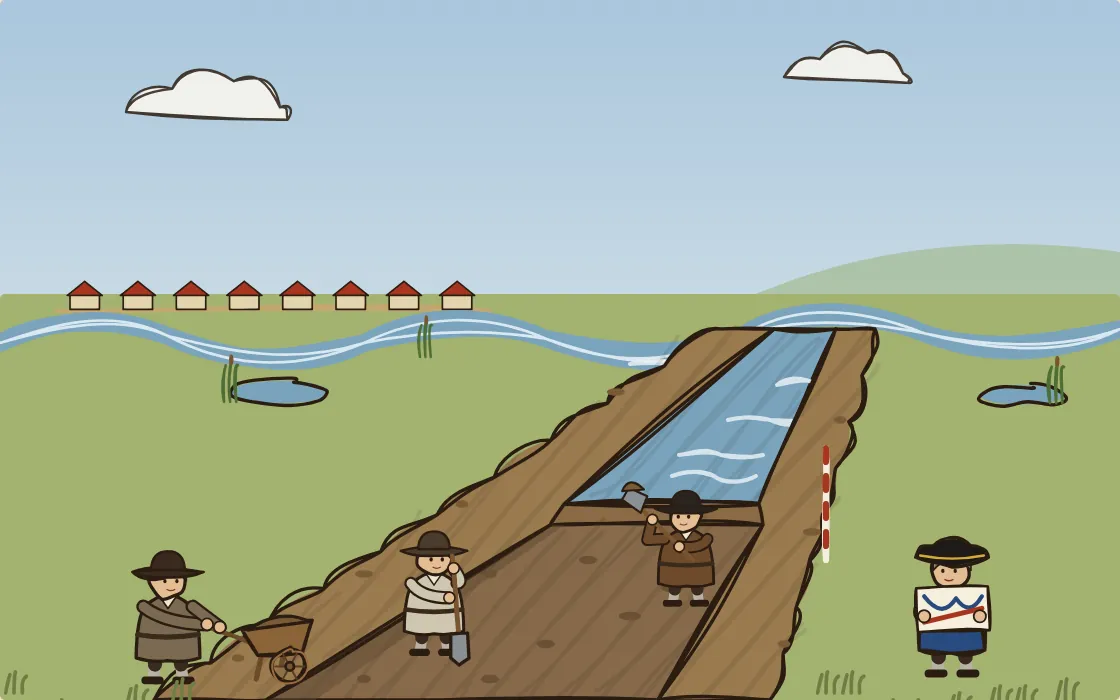
In six years, from 1747 to 1753, the shifting course of the Oder with its many meanders was fixed by cuts and dykes. A canal between Güstebiese and Hohensaaten shortened the river by about 20 kilometres.

From 1753 settlers from many lands of Europe came to the drained Oderbruch, and new villages were laid out on a regular plan.

SourceJ. Peters, Die Zukunft des Oderbruchs, bpb (2012)

The French in the Mark
1806

The French in the Mark

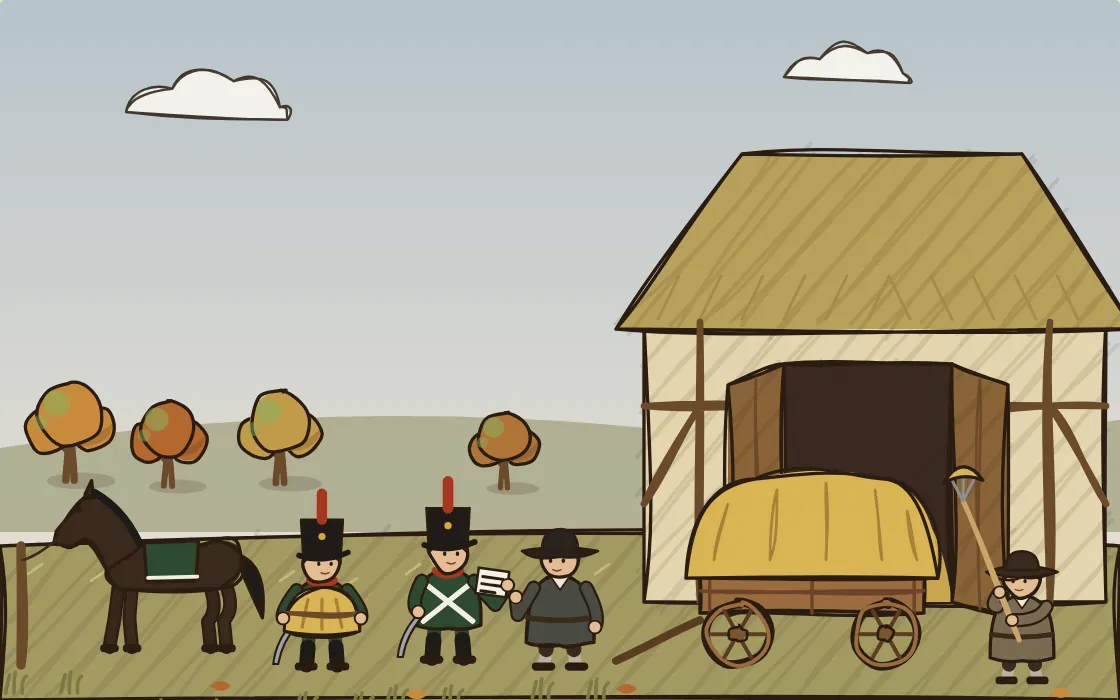
On 14 October 1806 Prussia was defeated at Jena and Auerstedt, and French troops occupied Berlin and the Mark.

The occupiers demanded food and fodder from towns and estates; hay and straw for their horses had to be delivered at short notice.

SourceR. Schmidt, Geschichte der Stadt Eberswalde, Bd. 2 ([1941]) 107–109; ADB 12 (1880) 685–686

People of the era

Martin Luther, 1520
Martin Luther, 1520
The elector’s official, 1542
A villager of the estate
Villagers of the estate, a merchant, a noble guest, a carter, a painter and the watchman of 1710
Era IV

The rescue, 1816–1842

David Gilly sees a picturesque ruin, Karl Friedrich Schinkel calls its preservation a duty, and from 1828 the church is rescued.

Scaffolding at the west front: the rescue, a spring noon
The ruin on an autumn afternoon
A winter night during the rescue

The goals of the era

  1. Schinkel’s visit, 1816

    Prepare the ruin for inspection: at least 60%. Karl Friedrich Schinkel will write that preserving so rare a monument becomes a duty.

  2. Saving the church, 1828–1842

    In 1828 the stables and storehouses were cleared from the church. In 1842 Ludwig Persius, commissioned by King Frederick William IV, took up the rescue again. Finish the work and restore the monument.

Pages of the chronicle

Schinkel saves the ruin

Schinkel saves the ruin

In 1816–1817 the architect Karl Friedrich Schinkel studied Chorin closely. He wrote that, given how rare such monuments were in the province, preserving this one became a duty.

In 1827 a new farm building was put up at the edge of the site, and in 1828 the stables and storehouses against the church were removed. Later Ludwig Persius, commissioned by King Frederick William IV, again took up the rescue of the church. The east wing had lost its upper storey and chapter house in the 1770s; in 1832 it was repaired to plans from Schinkel’s circle.

In his report for the Prussian building authority (drafted in December 1816, final text dated 8 January 1817) Schinkel described substantial remains of the monastery buildings, remarkable in many respects as works of old German architecture (“in vieler Hinsicht als Werke altdeutscher Baukunst merkwürdig”). At the time the vaultless church served as a barn and woodshed. The Kupferstichkabinett in Berlin keeps a series of his drawings of Chorin, probably made mostly on site.

After the first works, nothing more was done on the ruin from 1834 to 1842. In July 1842 Ludwig Persius inspected the church on behalf of Frederick William IV, made exact survey drawings and proposed restoring it at first only so far as to give the small congregation room (“um der kleinen Gemeinde Platz in derselben zu geben”).

SourceJ. Raue, Ein Mittelalterbild im Rahmen von Ordnung, Pflicht und Schönheit, in: N.-J. von Möllendorff, V. Ummenhofer (Hg.), Mittelalterbilder und Denkmalpflege, Bamberg 2023, S. 241–268; Museum Eberswalde (Th. Sander); Kupferstichkabinett SMB (SM 17b)

Cholera in 1831
1831

Cholera in 1831

In 1831 cholera reached Prussia for the first time, and in August it broke out in the Province of Brandenburg.

The authorities set up cordons and forbade contact with places where the disease raged.

SourceR. Schmidt, Geschichte der Stadt Eberswalde, Bd. 2 ([1941]) 136–137; C. Jütte, Die Choleraepidemie 1831, LeMO, DHM (2015)

People of the era

David Gilly, 1797
David Gilly, 1797
Karl Friedrich Schinkel, 1816
Ludwig Persius
Ludwig Persius
A travelling gentleman
A wanderer, a noble guest, a mason, a merchant and a servant, a village woman, a French quartermaster of 1806 and a Prussian official of 1831
Era V

Chorin today, since 1997

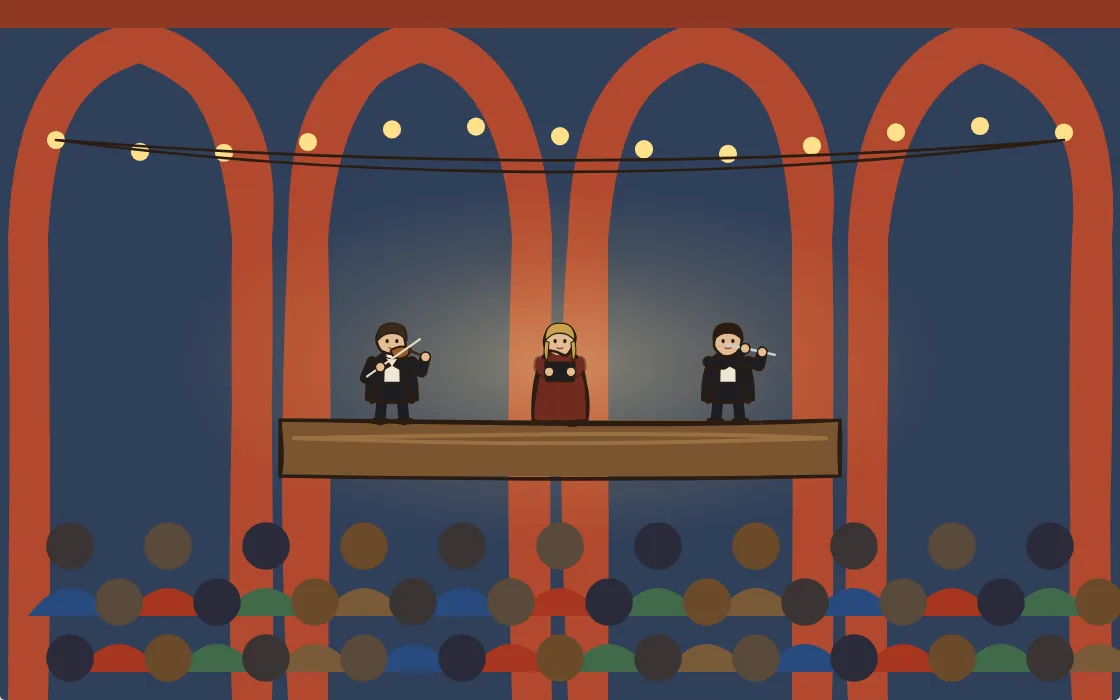
Since 1997 the former abbey has been in the care of the local Amt Britz-Chorin. Visitors come to the Amtssee, and in summer the Choriner Musiksommer fills the church with music.

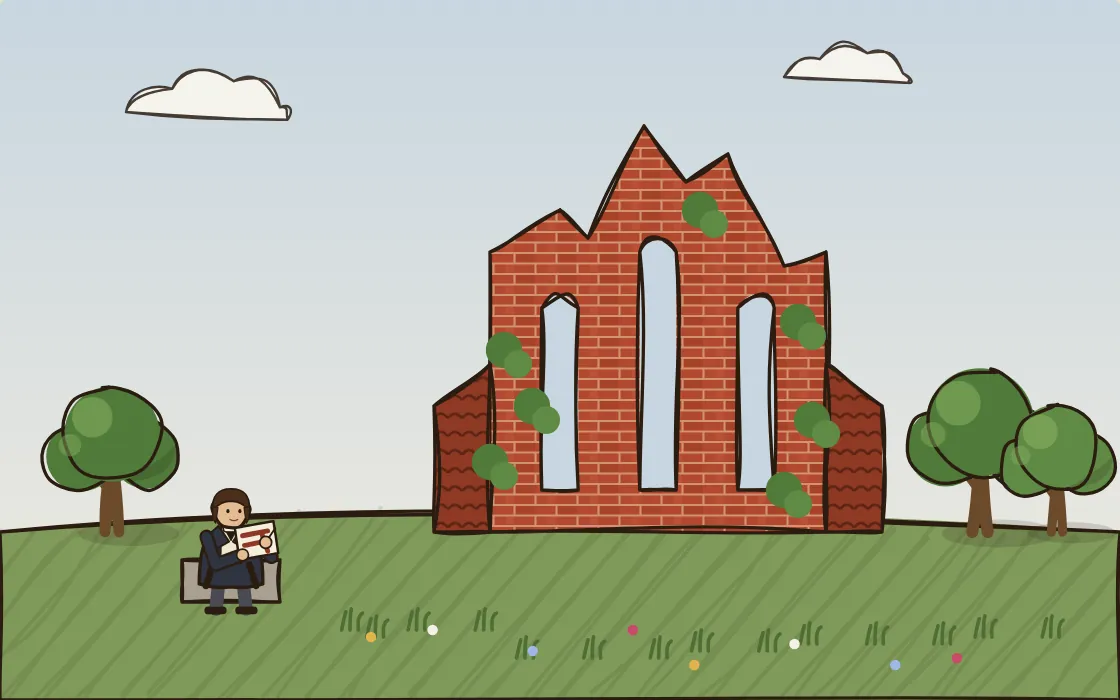
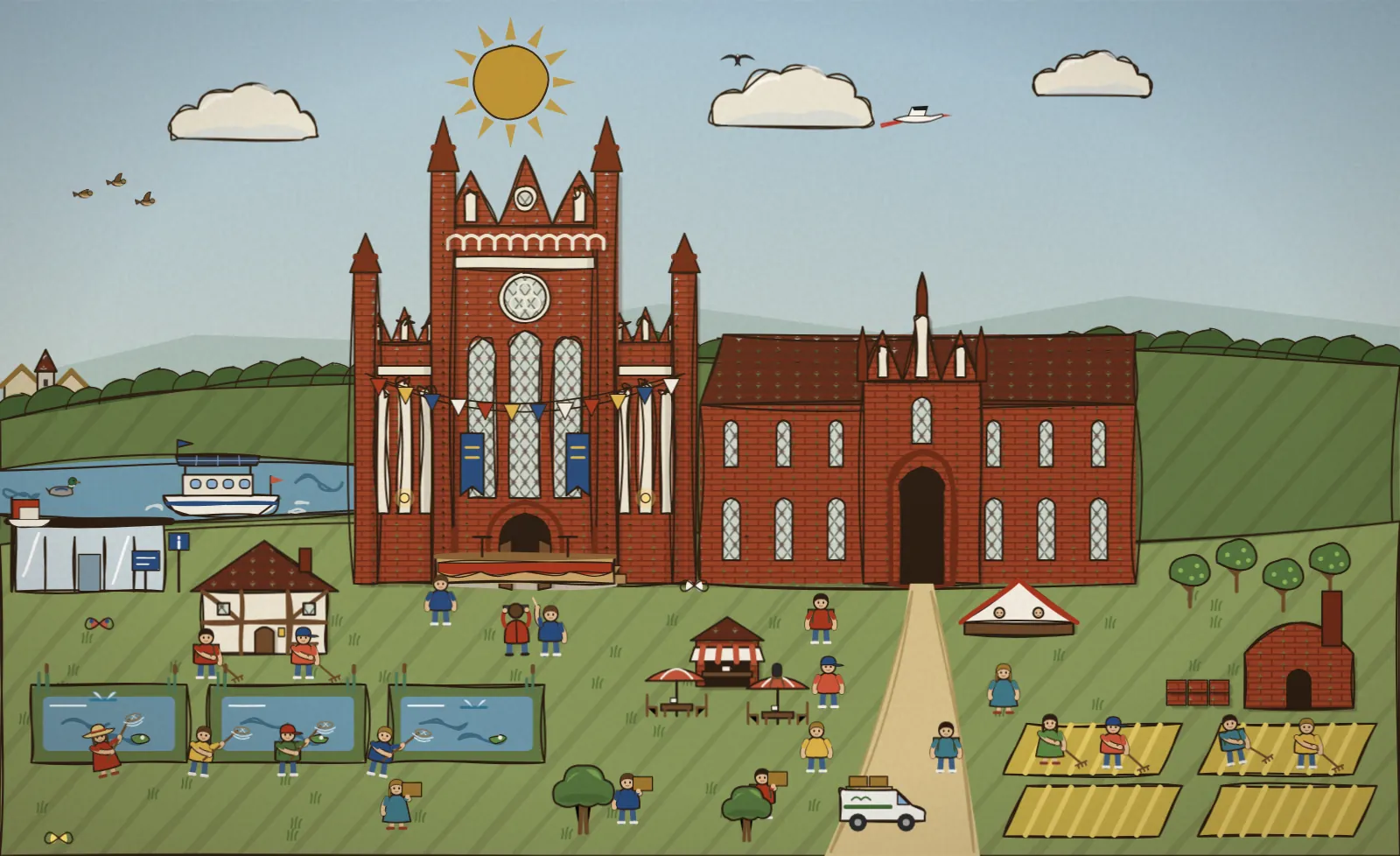
Chorin today: a summer afternoon
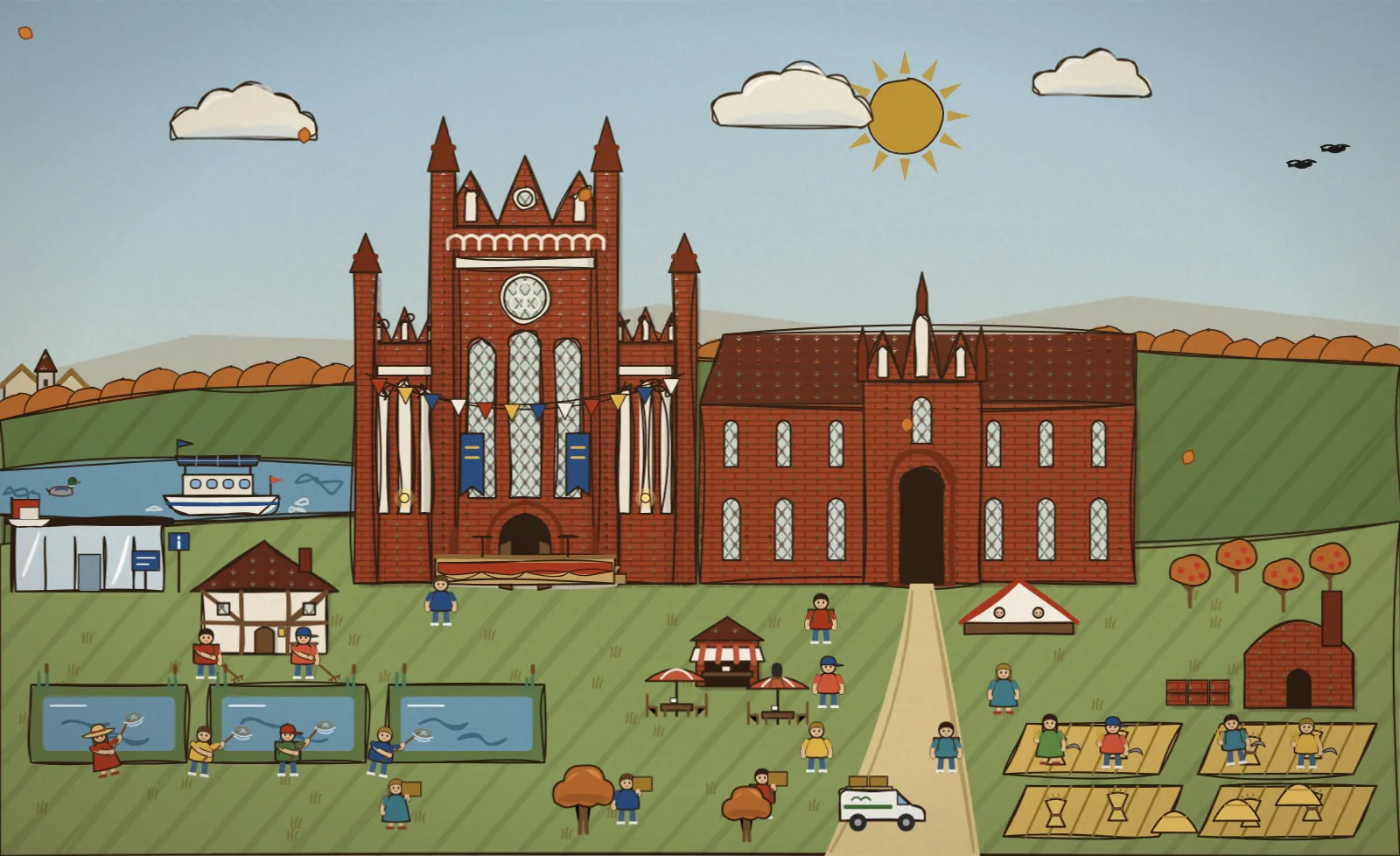
Chorin today: an autumn morning
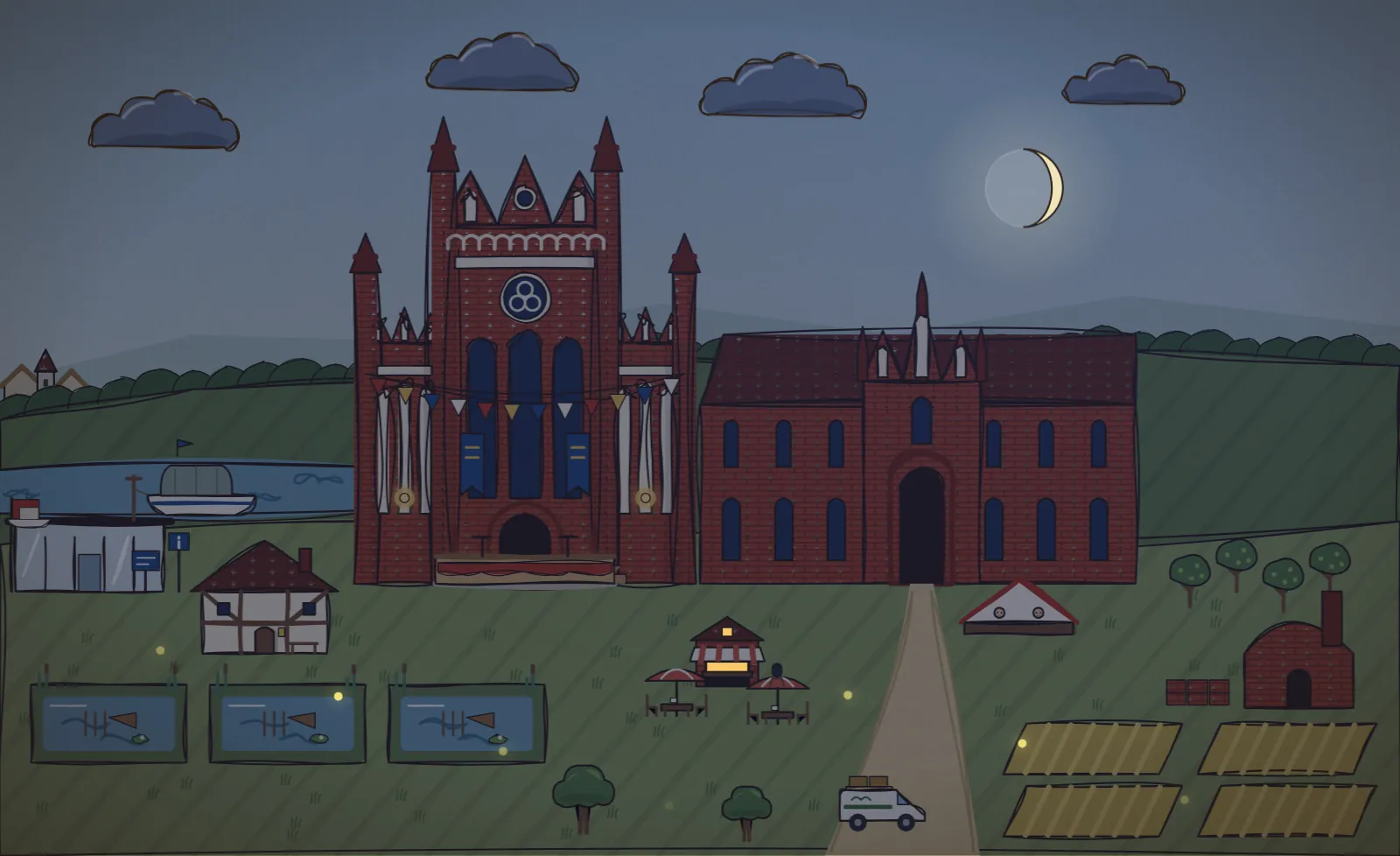
Chorin today: a summer night

The goals of the era

  1. Open the abbey to visitors

    In 1997 the local Amt Britz-Chorin took over the former abbey. Prepare it for guests.

  2. The Choriner Musiksommer

    The Choriner Musiksommer, held here since 1964, has grown into one of Brandenburg’s best-known music festivals. Give it the stage it deserves.

Pages of the chronicle

Chorin today

Chorin today

In 1997 the local Amt Britz-Chorin took over the former abbey. Since 1964 the Choriner Musiksommer, one of Brandenburg’s best-known music festivals, has filled the church in summer, and you can swim in the Amtssee.

Walking trails lead around the lake, and the free app “Kloster Chorin 3D” shows the abbey in Cistercian times.

Everything you built in the game can be seen in person: the trip from Berlin takes about an hour.

SourceKloster Chorin (kloster-chorin.org); Choriner Musiksommer e. V.; Kloster Chorin, Jahreskalender 2022

The Oder flood
1997

The Oder flood

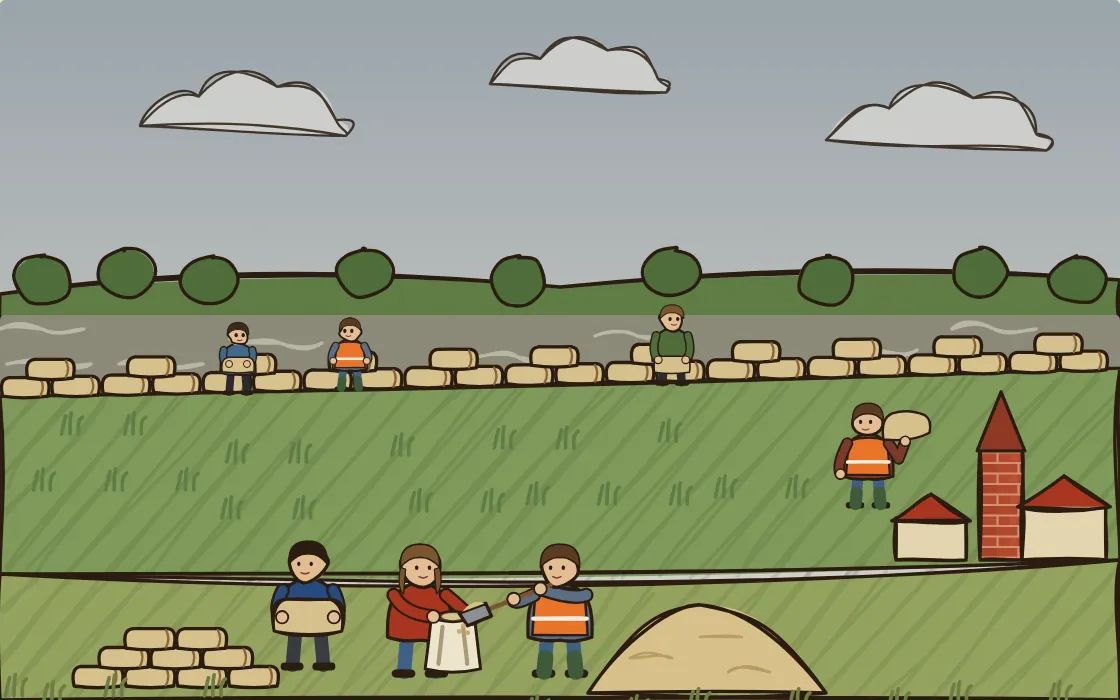
In July 1997 the Oder flooded. On 30 July a crack in the dyke at Hohenwutzen reached its crown, and it seemed the Oderbruch would be flooded.

Thousands of helpers saved it: they filled eight million sandbags.

SourceStaatskanzlei Brandenburg, Pressemitteilung zum Oderhochwasser 1997 (15.07.2017); J. Peters, Die Zukunft des Oderbruchs, bpb (2012)

People of the era

A visitor
A visitor
A visitor with her camera
A violinist of the Choriner Musiksommer
Walkers and visitors, a teacher with a child of her class, a market trader with a crate of apples and a volunteer of the 1997 flood

Write your own chronicle

In the game these pictures move: the seasons turn, the brothers work and pray, and the abbey grows with every decision you take. Era I is free to start.